AN INTRODUCTION TO BRITAIN'S HAUNTED PLACES
By True Ghost Story Author Richard Jones
On a bitterly cold and snowy April day, on my journey around the Haunted Places of Britain and Ireland, I climbed the muddy and uneven pathway that leads to the mysterious ruin of Dunstanburgh Castle on the wild and windswept Northumberland coast.

Dunstanburgh Castle
Embleton, Northumberland
Standing on its crumbling walls, with the raging waves crashing onto the rocks below, I thought back over the previous nine months during which I had journeyed all over Britain and Ireland, listening to accounts of true ghost stories, in search of haunted locations.
I thought of the people I had encountered at the various haunted places that I had visited all of whom shared one thing in common - they had seen a ghost.
HOW PEOPLE WHO SEE GHOSTS REACT
Many of their stories were, more or less, the same. Characters, times and locations changed but the basic essence of the experience didn’t.
What was noticeably different, however, was how those people reacted to their experience. Some felt it had, somehow, made them special and were only too willing to talk about it, often at great length. Others were very matter of fact, almost blasé, about what had happened. The majority were somewhat embarrassed, and showed a marked reluctance to talk about something that they were convinced would single them out as slightly eccentric and decidedly odd.
IT HAPPENED TO A FRIEND
Another aspect of my research that I encountered as I toured Britain's haunted places was what I came to recognise as the “happened to a colleague” syndrome. These were the second hand accounts, related to me by friends or family of those who had come into contact with ghosts.
I found it rather amusing how these stories were often climaxed with the statement that he or she was “stone cold sober at the time” or the way in which the witness was often described as “very pragmatic, the last person you’d ever expect to see this kind of thing”.
WHAT IS A GHOST?
But there’s the rub. What is the kind of person that might see “this kind of thing” and, for that matter, what exactly is this “thing” that we call a ghost?
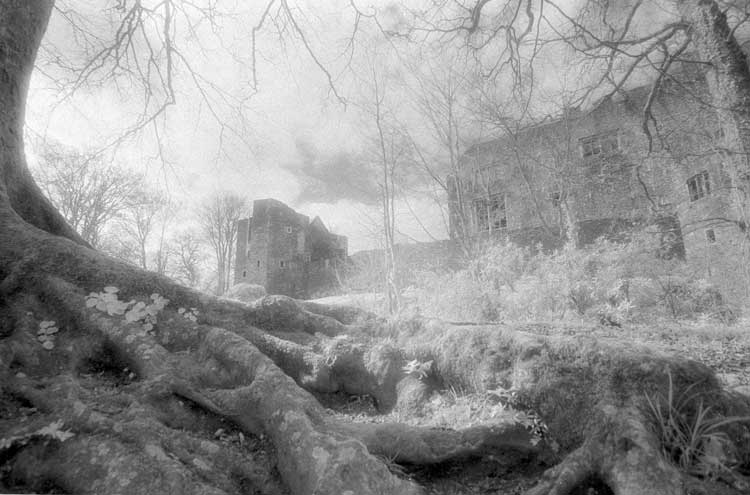
Berry Pomeroy Castle
Berry Pomeroy, Devon
The Concise Oxford Dictionary says that a “Ghost” is “an apparition of a dead person which is believed to appear to the living, typically as a nebulous image” and I suppose that is how most of us would define it.
DO YOU BELIEVE IN GHOSTS?
When my first book about haunted places Walking Haunted London was published, a question I was often asked was “Do you believe in ghosts?” I became very intrigued by my possible answer, since it forced me to think, “What is a ghost?”
ARE GHOSTS SIMPLY PSYCHIC IMPRINTS?
Surprisingly, in eighteen years of collecting ghost stories, I had never really stopped to contemplate this very basic question. I honestly do not believe that ghosts are the spirits of the dead coming back to haunt the living. My own opinion is that spirits, wraiths, revenants, spectres, phantoms, call them what you will, are emotional imprints, or recordings, that have been left on the surroundings of various haunted places, and that certain people, whom we call “psychic”, are simply more attuned to their wave-length than the rest of us.

Cliibon's Post
Nr. Datchworth, Hertfordshire
INVESTIGATING HAUNTED PLACES
And yet, ghosts continue to baffle, fascinate or outright terrify those who chance upon them. As I write these words, Hampton Court Palace, has called upon the services of parapsychologist Dr Richard Wiseman, to see if he can explain why several visitors have been taken ill, and fainted, at the spot where the ghost of Henry V111’s fifth wife, Catharine Howard, has long been said to appear.
WHAT TYPE OF PEOPLE SEE GHOSTS?
In addition to planning all night vigils, throughout which thermal imaging cameras will be pointed at the spot, Dr Wiseman plans to canvass around 600 visitors in an “attempt to pinpoint the character type most likely to report ghostly sightings”.
And yet the weight of evidence clearly demonstrates that ghosts do not appear to any specific type of person.
They are elusive and baffling - often choosing to appear before those who least expect to see them and, indeed, those whom you would least consider to be the type of person who would see them.
HAUNTED PLACES IN IRELAND
The Irish poet W. B. Yeats aptly summed up this spectral conundrum. Yeats was a great believer in Spirits and, accompanied by his friend Lady Gregory, he devoted a great deal of time to collecting and publishing the true ghost stories of the ordinary men and women of Ireland. In his biography of Yeats G. K. Chesterton stated that:-
".. he used one argument which was sound, and I have never forgotten it. It is the fact that it is not abnormal men like artists, but normal men like peasants, who have borne witness a thousand times to such things; it is the farmers who see fairies. It is the agricultural labourer who calls a spade a spade, who also calls a spirit a spirit; it is the woodcutter, with no axe to grind, who will say he saw a man hang on the gallows and afterwards hang around it as a ghost..."

A possible ghost caught on film
St Botolph's Church London
SCIENCE AND GHOSTS
Hundreds, if not thousands, of scientific attempts have been made to analyse and explain ghosts.
The results rarely,if ever, prove conclusive and the appliance of science to the tale of a haunting does, in my opinion, detract from what a ghost story really is.
A ghost story is an opportunity for us to connect with our past. To feel once again the fear and excitement of our long ago ancestors who inhabited a hostile and dangerous planet. To experience for ourselves the art of the story teller.
ANNE BOLEYN'S GHOST
Few people can truly believe that Anne Boleyn’s headless ghost, gallops in a black carriage, drawn by headless horses around the grounds of Blickling Hall, in Norfolk. But to tell the story, on a tempest tossed winters night, as the wind and rain rattle the windows, with only a lone candle for light, is to summon up the true magic of the aural tradition.
I venture that most people would rather hear the tale of Catharine Howard’s screeching ghost racing along the haunted gallery of Hampton Court Palace than would be interested in the statistics of light, humidity and temperature at the same spot over an eight hour period.

The Cardington Hangar
Cardington, Bedfordshire
THE BEST HAUNTED PLACES FOR GHOST STORIES
True ghost stories are, in my opinion, an integral part of Britain's heritage.
They have no place in the cosy and certain world of academia, but belong in the children’s playground, the local pub, sundry other windswept haunted places and, of course, the popular imagination.
THE POPULARITY OF GHOST STORIES
Many ghost stories do not stand up to scientific, nor for that matter historical analysis. And yet in an age of space travel, computers and mass communication their popularity is increasing rather than declining.
TRUE GHOST STORIES FROM BRITAIN AND IRELAND
Assembled on this website you will find a very personal collection of the various haunted places around England, Scotland, Wales and Ireland. From the outset my main problem has not been which of the haunted places should be included, but rather, which of them should be left out.
I began with details of over 3,000 haunted places, of which I visited around 1200. From those I selected what I considered to be the most entertaining and varied tales.
PINK, GREY, GREEN, BLUE AND WHITE LADIES
I was conscious of the fact that I could easily end up with a nebulous procession of white, pink, blue and grey ladies parading across the website, and so in most cases I have tried to record the circumstances behind the hauntings.
HAUNTED PLACES THAT YOU CAN VISIT
Aside from entertainment value my only other criteria for inclusion was that they must be places could visit. Thus, with very few exceptions, every location listed in this collection of true ghost stories is open to the public.

The Mackenzie Vault
Greyfriars Kirk yard, Edinburgh
I apologise to the “modernists” of the genre for the exclusion of supermarket, bingo hall or launderette hauntings. I am not a paranormal investigator but rather a collector of folklore.
To me ghosts belong on windswept moors, in old ruined castles, ancient inns or Stately Homes.
I have reported the stories more or less as they have been told to me by the people who know the various haunted places best, and I have made few attempts to explain why they happen. Rather, I have been more than content to just accept that they do.
I may find myself accused of being naïve and a little too accepting in my approach for we live in an age when everything appears to need an explanation. I would argue that everyone needs a little mystery in their lives, something to wonder at and ponder on - and haunted places can be a real thrill to discover.
THE END OF THE JOURNEY
That particular journey around the haunted places of Britain and Ireland ended on those windswept ramparts of Dunstanburgh Castle watching the awesome might of the breaking waves deposit their foam about the crumbling crevices of the once mighty fortress.
I thought of the men and women whose tragic stories had become enshrined in legend. I thought of Castles, sacked in war, which rose from the ruins stronger and more imposing - only to be destroyed again when the passage of time brought new rivalries and new wars.
I looked back on the mysterious stone circles that I had visited whose origins are lost in the mists of time and whose true purpose is destined to be never really be known for certain.
I pondered how insignificant we really are in the greater scheme of things and repeated to myself Shakespeare’s immortal words “we are such stuff as dreams are made on, and our little life is rounded with a sleep”.
Suddenly, I felt strangely at peace and very, very alone.
So please enjoy this collection of true British ghost stories, and please try to visit as many of these wonderful haunted places as possible.