

HAUNTINGS AND LEGENDS
OF THE MIDLANDS
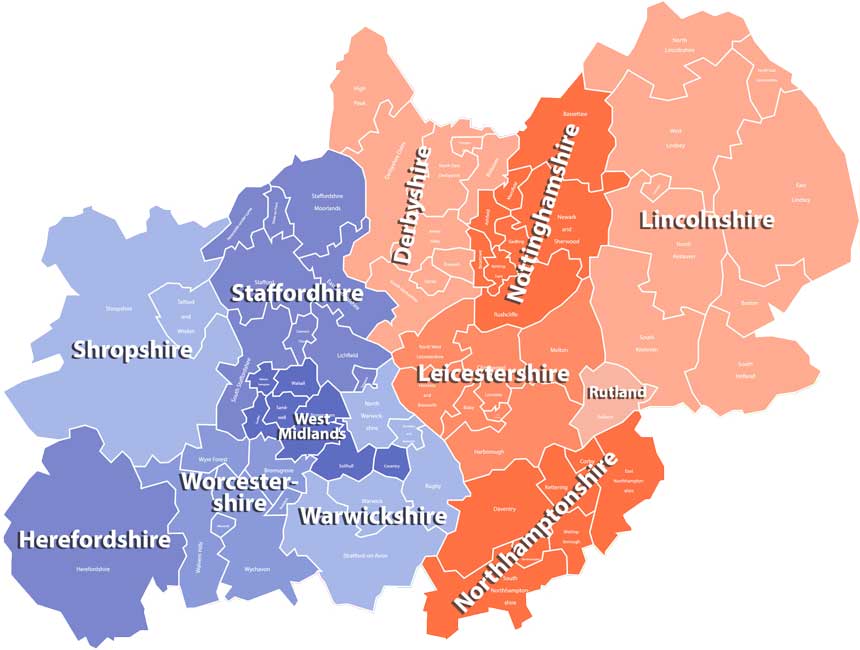
The counties that stretch from the Lincolnshire coast to the flat and arable pastures of Herefordshire and Shropshire, are steeped in some of the best-known legends of English history. The scenery ranges from flat stretches of coastline to rugged peaks and desolate moors and on through gentle valleys. Elsewhere, long-silent kilns and chimneys litter an industrial landscape, exuding an aura of mystery and detachment that is vaguely reminiscent of some of Britain's ancient monuments.
A REGION OF ENDLESS VARIETY
There is so much to occupy the imaginations of those who set out to explore the counties that make up the Midlands,
Who cannot wander the byways of Nottinghamshire without giving a thought to the world's most famous outlaw - Robin Hood? Who cannot gaze upon the melancholic expanse of Bosworth Field without conjuring up vivid images of the hunch backed figure of Richard III, shuffling his way through a winter of discontent, desperate to exchange his Kingdom for a life saving mount?
Witchcraft, and its perceived effects, are much in evidence across the landscape, and a tomb in the pretty parish church at Bottesford, Leicestershire, even tells of two boys being killed by "wicked practice and sorcerye."
Further south, Northamptonshire is indelibly linked with the fate of Mary, Queen of Scots - whose beheading at the long demolished Fotheringay Castle launched what is, arguably, the busiest ghost in Britain upon the spectral landscape.
Within the area's industrial heartland, you will find the awesome beauty of the Peak District, where rocky crags rise from rugged moorlands, and underground caverns conceal magical arrays of stalactites and stalagmites.
Elsewhere, gentle valleys, through which babble tranquil streams and rivers, nestle alongside foundations whose origins are long forgotten.
The picturesque pastures of Shropshire, meanwhile, belie a dangerous past when its border with Wales placed it at the vanguard against the threat of a Welsh uprising, and its inhabitants would keep a constant eye on the distant mountains, ever vigilant for the signs of an invasion.
An aura of departed greatness hangs over the region's castles, many of which dominate their surroundings, gazing down from their rocky thrones, their shattered walls reflecting past eras of grandeur and mystery.
Their ghosts belong to all ages and transcend the centuries, commemorating deeds that were sometimes brave, other times infamous, occasionally mysterious, but always fascinating.
GHOST STORIES FROM THE MIDLANDS
The Peak District is an area of outstanding natural, rugged, beauty. Nowhere else in England will you find such diversity of landscape. Industry has touched it, but left it relatively unscathed. Visitors flock to enjoy its windswept expanses and yet, with the exception of a few towns and villages, the area remains surprisingly un-crowded. It is an area steeped in mystery.
Some of its traditions can be traced back to Pre- Roman days, when the most powerful of the Celtic tribes - the Brigantes - ruled its moors and high lands. Circles of Standing Stones and windswept barrows litter the hills, testimony to a past dominated by the worship of the Old Gods.
Water was, of course, always important, but the worship of its deities has survived in this area like nowhere else in Britain. Throughout the summer months there is hardly a village that does not take pride in dressing its wells and springs with floral offerings, echoes of a distant past when these places were seen as portals to the other world.
From the 18th century onwards, writers such as Izaak Walton, Charlotte Bronte, George Eliot and D.H. Lawrence sought inspiration here, whilst celebrated travellers such as Defoe, Boswell and Byron found themselves diverted by its rugged wildernesses.
Today the area still maintains an aura of mystery. More UFO sightings take place here than in any other part of England.
There are Haunted Manor Houses that have changed little in hundreds of years. Wild and bleak moorlands where the "The Devil’s Bonfires" can still flicker in the early hours.
There are Deep Mountain pools steeped in legend and even a phantom aircraft that constantly sparks a full scale emergency alert!!
And just to round off an enjoyable day spent visiting mysterious places - there are an abundance of historic inns, where you can enjoy a hearty meal by a roaring fire or even spend the night in a haunted bedroom. Bon Voyage!
EYAM, DERBYSHIRE
The Villagers Who Chose To Die
The Village of Eyam, nestles in a hollow, surrounded by hills which stretch upwards onto high moorlands. It is a remote and isolated village of pretty, stone cottages. It has a manor house, a church and a haunted inn.
But it also has a sad an poignant past, reminders of which glare down from every cottage or lie scattered about the gardens and surrounding fields.
Next to the Parish Church stand a line of houses which share the collective name "Plague Cottages."
In one of these in 1665 there lodged with Mary Cooper, a tailor named George Viccars. In September he received a parcel of damp cloth from London which he spread out to dry before the fire. Unbeknown to him, Viccars action released upon the village plague carrying fleas whose bite would, within the next twelve months, decimate the small community.
The first victim was Viccars himself, who died of a "strange fever" on 7th September 1665.
Within two weeks his landlady’s young son Edward Cooper had also died and the villagers braced themselves for the horror which they knew lay ahead.
By early October the plague was raging and, under the leadership of their Vicar, William Mompesson, the villagers made the brave and, for many fatal, decision, to cut themselves off from the outside world in order to prevent the pestilence from spreading throughout the district.
The church was closed. Families buried their dead in their own back gardens or fields. Supplies were left at a well outside the village, now called Mompesson’s Well, and which is clearly sign-posted from the church. Payment was left in hollows in the stone which were filled with vinegar to purify the tainted currency.
By the time the last victim died on November 1st 1666, the outbreak had claimed the lives of 260 residents from a population of 350.
William Mompesson's wife, Catharine, had died on August 26th 1666 and her gravestone can still be seen in the churchyard.
The villages heroic act of self sacrifice is still remembered annually at the end of August, when the village holds "Wakes Week." This colourful festival consists of well dressing and commemoration, and culminates in an open air service, at the end of which the current rectors wife lays a bunch of roses upon the grave of Catharine Mompesson.
Strolling through the village of Eyam, it is difficult not to shudder at the constant reminders of that fateful year. Most of the cottages are adorned with small plaques, listing the residents who succumbed, together with the dates of their deaths.
At diverse other places, you come unexpectedly upon the victims graves.
A little way along Lydgate, in a shady nook, beneath a tall oak are the weathered tombstones of George and Mary Darby.
At the end of a dirt track on the outskirts of the village, a dry-stone wall circles the seven graves of the Riley Family, whilst in the middle of a field behind Hollins Farm stands the tomb of Humphrey Merrill.
I can think of nowhere else in England where the tragedy of the past is so manifest in the present and, although the village does not dwell morbidly on those long ago events, a strange and eerie stillness certainly hangs over it.
The Miner's Arms
Eyam, Derbyshire
The Haunted Village Inn
The Miner's Arms dating from the 1630’s, and as cosy a pub as you could wish for when the winter winds blow down from the moors.
Tradition tells how the previous building on the site burnt down in 1629, and how two young girls, Sarah and Emily, lost their lives in the fire.
Regulars have often heard their girlish footsteps skipping about the rooms of the current building.
Many residents spending the night here, have complained of their respite being disturbed by ghostly activity, such as their room doors being open and closed, an action which appears to bring much merriment to their spectral tormentors, for it is often followed by a peal of girlish giggling from the corridor outside.
Haddon Hall
Where the Course of History was Changed
Picture a rambling castle that has changed little in hundreds of years, hidden amongst green trees, standing high and proud on a lime- stone ridge, which in the early morning floats magically on a carpet of swirling mist.
Such a place is Haddon Hall, a fairy tale Manor House, built by Richard Vernon in 1170. It stayed under the ownership of that family until the late sixteenth century when it passed, by marriage, to the Manners family whose descendent Lord Edward John Francis Manners now resides at this wonderful old house.
In recent years it has been used as a film location for the likes of Jayne Eyre , The Prince and The Pauper, Moll Flanders and Elizabeth.
The Hall has changed little, if at all, since the reign of Henry V111. The walls of its dark rooms are hung with splendid 17th century tapestries (one of which is said to have caused great mirth to the young Princess Victoria when she noted that her courtiers were still dressed in identical fashions).
Its stone steps and flagstone floors are worn by the ravages of time and its ancient fabric positively crackles with the of events to which it has born silent witness.
The psychically inclined have, understandably, detected much ghostly activity here. They tell of cold spots on stone staircases, of a white lady who drifts across the impressive 14th century banqueting hall, and of a ghostly dog whose yapping is heard in the beautiful gardens that have been called "the most romantic in England."
But Haddon Hall’s best attested legend concerns its involvement in a stroke of fate that literally changed the course of English history.
A frequent visitor to the Hall in the early years of the 16th century was Prince Arthur, eldest son of King Henry V11, and heir to the throne.
One September evening in 1501 following a strenuous days hunting, the Prince rested on the leafy banks of the river Wye in the grounds of Haddon Hall.
A tall woman, dressed in white with "features sunken and wan.. lips of ashy hue and eyeballs protruding bright and motionless" appeared to him in a dream and warned him: "Unhappy Royal Prince.. One earthly Pageant awaits thee, yea, it is at hand; and then, ah! then, thou wilt drop into the lap of thy mother earth! Forth comes to Britain's shore thy lovely, smiling bride - ah! and widow of a royal boy!"
When the Prince returned to the Hall that evening, he was greeted with the news that his bride to be, Catharine of Aragon, had arrived in England and that he was to be married without delay.
But, not four months after his wedding, he died of a sudden illness, his last words are said to have been being "O, the vision of the cross at Haddon!"
With his untimely death his brother, Henry, became heir to the throne, married his brothers widow and the rest is history.
Hayfield, Derbyshire
The Day The Dead Rose
The pretty village of Hayfield is watched over by Kinder Scout, the highest mountain in the region.
Hayfield possesses a sturdy, squat village church where in 1754 a quite extra - ordinary happening is said to have occurred.
"On the last day of August," according to a contemporary account, a communal grave suddenly opened, hundreds of bodies suddenly rose from their coffins and began to ascend heavenwards "to the great astonishment and Terror of several spectators."
Singing in Consert," they began to ascend heavenwards "to the great astonishment and Terror of several spectators."
They left in their wake a "fragrant and delicious odour" and one of the Peak Districts most abiding mysteries as to what exactly happened on that long ago August day.
Kinder Scout
From the village, a narrow road arrives a car park, from which a steep walk onto the slopes of Kinder Scout, brings you once more onto the rugged wilderness of the high moors.
The view of the mountain as it looms before you is strangely foreboding.
In the summer months, the smell of purple heather fills the air and the distinctive cackle of the red grouse can suddenly rend the air, raucous and startling.
In winter, the raging waters that come thundering down over Kinder Downfall, are blown back by the constant wind the resultant spray causing hundreds of tiny rainbows to hang in the air, lending an eerie, mysterious aura to the surrounds.
The fleeting glimpses of rare white mountain hares, as they bound across the turf add to the mystery, for these were always associated with wizards and warlocks.
It has been suggested that "Kinder" may be of Celtic origin and come directly from the Germanic "Kunder," meaning creature, being or prodigy.
In a shallow ravine, close-by Kinder Downfall, there is a dark, melancholic pool, ringed by squelching bog land in the depths of which is said to live a mermaid. She may well be the "creature" to whom the mountains name refers.
The Mermaid of Kinder Scout
It is a pool of lifeless marsh water.
No animal will drink from it and no fish swim in its murky depths.
A feeling of desolation pervades its shore as though some malign influence has cast a dark spell over the landscape.
It is said that if you gaze long and hard into the rippling black water you will be rewarded with visions of what the future may hold.
This has long been a sacred spot and there is evidence to suggest that human sacrifices were once carried out here.
The Celts believed that pools such as this were portals to the other world and the sacrifices were intended to appease the Spirits that dwelled beyond these gateways.
From this tradition has evolved the legend of the mermaid who, tradition holds, can only be seen on Easter eve at midnight.
Those who undertake what is no doubt an exhausting and eerie journey on the given day at the witching hour, will see the mermaid swimming towards them.
Breaking the surface, she will stretch forth an ice cold hand and either bestow upon you the gift of eternal life or else drag you to a watery death in the bottomless depths of her pool.
The last person to keep this vigil was journalist Sheila Wright who actually camped out by the pool in 1998.
Her vigil was, however, ruined by the antics of several other watchers who had chosen to celebrate the occasion by communing with spirits of a very earthly variety.
Longdendale
The Haunted Valley
Longdendale, "the long valley," stretches for ten miles, through some of the regions most remote and ruggedly beautiful countryside.
Towering above it are two mountains whose very names conjure up mystical images "Bleaklow" and "Shining Clough."
It is untamed country. One road circles its outer reaches, but the only way to get into its remote hinterland, is on foot. It is bleak but beautiful, haunted and mysterious; or, as Daniel Defoe put it, "the most desolate, wild and abandoned country in England."
Scattered across the high moor are the rusting wrecks of dozens of World War Two aircraft that crashed into these unforgiving peaks almost sixty years ago.
The fact that there are more ghostly encounters, unexplained happenings and UFO sightings here, than anywhere else in the Peak District, has led to it being dubbed in recent years "The Haunted Valley."
Longdendale Lights
To traverse the desolate Bleaklow mountainside as the last rays of daylight cast the eerie glow of twilight across its brooding shadows is to feel truly alone and vulnerable.
For travellers who passed this way a hundred and more years ago, when the terrain was much wilder, and superstition had a tighter grip on the popular imagination, the experience must have been terrifying.
But the hardships of those long ago times, meant that many had cause to venture onto the wild moors at night, and the ordeal must have been made all the worse for those who chanced upon the Longdendale Lights.
These strange, flickering lights or balls of blue flame were known locally as the "devil's bonfires" and they were attributed to the fairy folk, wil o’ the wisps or boggarts.
Some believed that they were the work of witches, whose evil intent was to lure the unwary to become sacrificial victims. There are records of them as long ago as the 16th century though they were, no doubt, a firm night time fixture long before.
They are still a baffling feature of this lonely wilderness, although these days they are often attributed to UFO’s.
People have spoken of rounding the hairpin bend on the B6105 known as "Devil’s Elbow" to find themselves suddenly dazzled by a powerful blue light that shines from a nearby field, but which suddenly disappears should they approach it.
The local mountain rescue team have been called out on many occasions to search for what were presumed to be the torches, or even flares, of lost ramblers.
They have got used to the flickering lights fading slowly away as they get closer to them.
On a warm summers night in July 1998, the residents at the nearby Youth Hostel were amazed when the entire district was suddenly lit up by a brilliant blue light that shone from somewhere on Bleaklow.
It was visible for over three minutes and was seen by so many people that a full scale search was undertaken by the emergency services.
But, as on previous occasions, its source was never found.
The Longdendale lights have never been satisfactorily explained.
It has, however, been suggested that they may be responsible for the high number of planes that have crashed onto the moors.
Some wonder if the crews perhaps mistook them for direction beacons and followed them into the hillsides. Whatever the cause, the wreckage that litters the landscape is now a permanent feature of the terrain and the most recent and publicised of all the valleys hauntings concerns the
The Phantom Bomber of Longdendale
There have been hundreds of reports in the last fifty years of ghostly planes flying over the valley. They have been seen by hikers plodding their weary way home in the fading light of early evening. By farmers tending their cattle. Policemen, fire crews, and other emergency workers.
On Thursday July 22nd 1954 two Sabre 4’s of 66 Squadron disappeared over the peaks. The crashed fighters were discovered the following Sunday by two ramblers who alerted the emergency services.
Eventually the bodies of the pilots were recovered and carried off the high moor, although the wreckage was left strewn where it had fallen.
The two pilots were experienced fliers, both planes were brand new and the cause of the accident remains, officially, unknown to this day.
The radio transmissions between the two pilots, shortly before they disappeared, however, provide a tantalising hint of a cause. It is evident that the two were flying in low cloud and were lost. "Where are we?" Asked one. "I’m not sure," came the reply. But then the second pilot apparently spotted a third plane and issued the fatal order "just follow the other jet through the cloud."
Those were the last words he spoke and, since no other planes were known to be flying in the area at that time, rumours abound that the two pilots were lured to their deaths by the appearance of the phantom bomber.
The most recent sighting of the spectral plane took place in March 1997, when Maria France and a companion had headed onto the high moor at around 10pm one night in the hope of enjoying a view of the Hale Bop comet.
As they gazed into the clear night sky, a low flying plane suddenly appeared above them. They watched as it passed overhead and rounded the peak, where it disappeared from view. It was then they realised that, despite the fact they could clearly see its huge propellers whirling round, there was no sound emanating from the mysterious aircraft.
There were, however, other startled witnesses to the phantom flight that night. These included a farmer who saw it round the peak and come diving toward him. So convinced was he that it was a real plane, that he instinctively dived to the ground and prepared himself for the inevitable impact.
A short time later several witnesses heard the sound of a plane crashing and saw an orange glow light up the sky.
Within moments the emergency services were inundated with phone calls from concerned locals reporting a plane crash on the high moors.
But despite the fact that hundreds of emergency workers scoured the area for more than fifteen hours, no fresh wreckage was discovered and no plane was ever reported missing.
The Haunted Valley exerts a powerful grip on the imagination. It is a wilderness for wanderers without watches. It captivates and terrifies in equal doses. So absorb its atmosphere. Walk its twisted trails across the rugged terrain, and listen as the wind whistles its mournful tunes through the gaps in the grit stone rocks.
And, as the night falls across Bleaklow and Shining Clough, plunging the landscape into darkness, you may spy a flicker of light on the lonely moor and know that, even in this enlightened age, there are still things that remain mysterious and unexplained.
For, when the shadows of the night close in, the Haunted Valley’s other residents stir once more into ghostly life.
Snailbeach Lead Mines
The date 1881 is emblazoned in white letters on a tall brick chimney.
The ruinous buildings cling eerily to the lower slopes of a wooded hill, still silent and brooding.
A cold tunnel where a rusting carriage stands on rusting tracks which stretch into the darkness of a brick lined tunnel rusting remnants of old carriages on the equally rusting tracks that stretch into the cold eerie darkness of a brick lined tunnel that disappears into the side of the hill on which the mine buildings stand.
At one time close on 500 people were employed at this the largest of the many mines that once dotted this sleepy Shropshire countryside.
Competition from overseas lead mines lead to a decline in the industry in this country and the mine was closed in 1911. Slowly the tunnels were allowed to flood.
The brickwork crumbled away, its proud walls toppled and fell as the weeds crept unchecked over the site.
Lilleshall Abbey
The extensive and evocative ruins of this Augustinian Abbey date from the 12th and 13th centuries. It was a Royalist stronghold in the Civil War.
Its a peaceful setting on green lawns and ancient yew trees.
Dark, forbidding winding spiral staircases lead to precarious parapets which afford stunning views across the surrounding countryside.
A peaceful and tranquil location.
A grim – visaged spectral monk is said to wander the crumbling ruins on summer evenings causing consternation to those who happen to cross his path.
Even more alarming, though, are the agonised screams that have been known to shatter the tranquil silence and cold shivers racing down the spines of those unfortunate enough to be present when long a forgotten murder or terrible bout of medieval torture is re-enacted by the ghosts .
Little Moreton Hall
This timber-framed moated manor house with its reeling walls that lean at drunken angles and tiny mullioned windows walls that lean at strange almost drunken angles, a picturesque moat and an inner cobbled courtyard.
A grey lady haunts the spectacular long gallery, drifting by astonished witnesses only to fade slowly away as they turn to look at her.
More disturbing are the heart rending cries of sobbing child that have been heard in and around the chapel.
Capesthorne Manor
An imposing huge pile of magnificent red brick Capesthorne manor is believed to have been the designed in 1722 by John Wood famed architect behind the transformation of Bath.
It’s proximity the sleek white modernity of the satellite dishes of Joderell Bank make a bizarre neighbours.
A number of phantoms haunt the stately pile. A ghostly procession of "writhing grey figures" has been seen descending into the vault beneath the chapel while the wraith of a mysterious grey lady has surprised many visitors as she drifts around the corridors and cubby-holes of the house.
But the most bizarre and indeed frightening paranormal experience befell a member of the family who one dark night in 1958 was woken by the sound of his bedroom window rattling noisily.
Looking across at the window he saw a severed arm which was apparently attempting to open the window. Leaping from his bed he moved to the window and reached out towards the latch, whereupon the ghostly limb suddenly vanished.
Gawsworth Hall
This attractive half-timbered manor house dates largely from the 15th century.
It was once the home of the Fitton family whose wayward daughter Mary was Maid of Honour to Elizabeth 1st and a possible contender for Shakespeare’s "Dark Lady" of the sonnets.
Her effigy can be seen in the nearby church, kneeling behind those of her sister and Mother Dame Alice Fitton, who rests her head upon her hand perhaps in weary acceptance of her youngest daughters fecklessness.
A ghostly lady resplendent in "ancient costume" has been seen around the courtyard of the old house whilst several guests have been troubled by the inexplicable smell of incense drifting from the vicinity of the Priest’s Room.
In 1921 an old cupboard was removed from the oratory where an escape hatch led to the cellars. Workmen were horrified to discover a skeleton hidden behind the cupboard. The bones were buried in the churchyard but this did not seem to placate the phantoms in the area for the smell of incense continues to pervade from the vicinity of the priests hide.
Gawsworth with its long history, its memories, shadows and secrets is a jewel in the Cheshire countryside. It’s ghosts drift aimlessly through its ancient rooms.
There are numerous tales of ghostly activity within the magnificent walls of the old house.
Lyme Park
The cold and aloof exterior of the palatial Stately home that nestles amidst its own immense lush grounds is not in the least bit inviting or even welcoming.
A weariness hangs over its cold stone floors and pervades its echoing corridors whilst the inner courtyard of brown-grey sandstone with its chipped marble floor is positively dreary.
Yet upon entering the house you find yourself wandering through a labyrinth of dark wood corridors and rooms that are both cosy and immense.
Period furniture and hanging tapestries, Grinling Gibbons carvings and secret panels.
One of the first owners of a house on this site was Sir Piers Legh who died while fighting for King and country in Paris in 1422.
His body was brought back for burial at Lyme Park and his grief stricken wife Lady Joan, watched the sorrowful cortege wend its weary way along the drive to her slain husbands final resting place at a site thereafter known as "Knights Low" or "Knights Sorrow."
Unnoticed in the cortege was Piers mistress, Blanche, who following his interment made her way to the nearby banks of the river Bolin and pined to death.
When her body was discovered they buried poor Blanch on the spot where the meadow became known as "Lady’s Grave."
And on stormy nights when the swirling clouds move eerily across the face of the moon casting and the trees cast strange writhing shadows across the windswept park a ghostly procession is said to move slowly along the drive and a little way behind drifts the white grief stricken figure of Blanch her wailing cries rising eerily above the howling winds and driving rain.
In the upper rooms of the house itself the impressive long gallery leads the intrepid visitor to the "Knight's Bedroom, "which on account of the fact it is haunted is known as "The Ghost Room."
There is a tradition that Mary Queen of Scots slept here while she was a prisoner of Queen Elizabeth 1st.
In the 18th century the skeleton of a priest was found beneath the floorboards.
The room is very dark with an ornate fire place the room is dominated by a massive four poster bed with demonic faces carved upon it.
People have come out of the room speaking of the sweet though ghostly smell of oranges that seems to pervade the air.
A young child visiting the room in 1999 suddenly went into hysterics and began pointing wildly at the bed insisting that he could see children playing on the bed.
The white lady haunts the woods outside.
A haunting atmospheric interior of dark wood panelling greets the visitor on crossing the threshold into this building.
Hellens Manor
There is now a dedicated page to Hellens Manor.
Woodchester Mansion
Woodchester Park, Nympsfield, Gloucestershire
Woodchester Mansion now has its own exclusive webpage
The Ancient Ram Inn
Wotton-under-Edge, Gloucestershire
There is now a page dedicated exclusively to the haunted Ancient Ram Inn
Hergest Court
We now have a dedicated web page that tells you about the ghosts and legends of Hergest Court
The New Inn, Pembridge
Learn about the ghostly goings-on at the New in on its new exclusive web page.
Dudley Castle
Dudley, West Midlands
Dudley Castle – the ragged remnants of which stand atop a lofty, limestone crag, and which are reached via a brisk stroll through Dudley Zoo – was founded in 1071. It was massively refortified in the 12th and 13th centuries by the then owners the de Somery family who, tradition holds, resorted to violent extortion to fund the expansion.
At least one member of this brutish clan may still reside amidst the shattered ruins.
In a dimly lit corner of the castles lecture room are two halves of an enormous medieval stone coffin, the original occupant of which must have been a giant of his time.
It came from Dudley Priory, where the Lords of Dudley were once buried, and is believed to have once held the mortal remains of John de Somery, who died in 1322.
However, in 2002, an historical dowser detected that the two sections of the coffin, whilst both being from the 14th century, were of different dates and, therefore, may well be the remains of two different caskets.
Such a discovery, of course, is merely academic.
Unless, that is, you happen to be one of the former incumbents, whose earthbound spirit has remained trapped at your place of interment.
A cleaner, working in the room one day, happened to glance over in the direction of the coffin, and saw a pair of feet, clad in a pair of thigh length riding boots, standing next to it. Her alarm intensified when she realised that the figure was minus the upper half of its body! Is it possible that the cleaving in two of his resting place has condemned John de Somery to lead a somewhat truncated ethereal existence?
From the de Somery’s, the castle passed by marriage to the de Sutton family, and then in the mid-16th century came into possession of John Dudley, Duke of Northumberland, who set about creating an abode that would match the lofty, and ultimately fatal, heights of his dynastic ambition.
When Henry V111 died in 1547, John Dudley became Protector to the young Edward V1.
Following Edward's death in 1553, Dudley conspired to make his own daughter-in-law, Lady Jane Grey, Queen of England, thus by-passing the rightful heir, Mary Tudor.
When the plot floundered, due to the country as a whole supporting Mary’s claim, his fellow conspirators quickly deserted him, and John Dudley was forced to surrender to the mercy of Mary 1st.
This was not forthcoming and he, his son and the unfortunate nine-day Queen, Lady Jane Grey, were all executed.
The castle reverted to the Sutton family and thereafter sank into decline.
Garrisoned by the Royalists during the Civil War, it was besieged by the Parliamentarian’s. But following the defeat of Charles 1st at the Battle of Naseby, it was surrendered on 13th May 1646 and the Keep, Gatehouse and portions of the curtain wall were subsequently slighted.
Although the then owners, the Ward family, continued to use the domestic range, they appear to have had little enthusiasm for it and when, on 24th July 1750, it was engulfed by fire, the flames were allowed to burn unabated for three days and nights.
Dudley Castle then settled into its role of romantic ruin until, in 1937, it was incorporated into the zoological gardens, above which it now looms.
Disembodied legs aside, many spirits linger around the lofty remnants.
A group of intrepid ghost hunter’s who volunteered for a sponsored overnight stay one Halloween, were startled in the early hours by a mysterious figure, seen pacing across the parapets. Who, or what, it was has never been ascertained and it has never been seen since.
The wraith of an old lady, who hanged herself from the ramparts when her cat was killed by local youths, has also been known to return occasionally to the place of her suicide.
A Civil War drummer, who was picked off by a single shot from the battlements as he attempted to take a message offering terms of surrender to the garrison, is also seen from time to time.
But the most famous of all the ghosts is that of the grey lady, whose sombre shade drifts around the parapets of the old keep at sundry times of the day and night.
She is thought to be Dorothy Beaumont, who died at the castle during the siege of 1646, apparently of natural causes.
The Parliamentary commander, Sir William Brereton, allowed her funeral cortege to pass though his lines and she was buried in the church at the top of Dudley High Street.
But, the fact that her infant child had died before her, and been laid to rest in the towns lower church, which was closer to the castle, proved too much for Dorothy’s spirit, and her ghost wanders the castle seeking the baby whom fate, and the length of Dudley High Street, have separated her from for the whole of eternity.
Staff have long since grown accustomed to her wanderings, whilst numerous bemused visitors will testify to her existence.
In the course of one of the ghost tours now staged at the castle, an actor was employed to play the part of Dorothy’s ghost. At the crucial moment when the castle keeper, Adrian Durkin, was regaling his audience with her heart-rending tale, participants were puzzled by the appearance of second grey lady behind the actor.
Talbot Hotel
Oundle, Northants
With the possible exception of Anne Boleyn, Mary Queen of Scots must have possessed one of the most psychically charged persona’s to ever drift across the pages of history. There is hardly a castle or house that she visited, and several that she didn’t, which is not now haunted by her tragic shade. The place where you would certainly expect to encounter her wraith is, of course, Fotheringay Castle, in the great hall of which she was beheaded on February 8th, 1587. But the Castle was long ago demolished, and all that now remains, is a melancholic mound in the grounds of a farmhouse. Much of the its stone was used for new building in the neighbourhood, and many of its furnishings ended up at sundry other locations.
When Mary’s son James 1st ordered that Fotheringay Castle was to be razed to the ground, the landlord of the Talbot Inn, William Whitwell, saw an opportunity to refurbish his hostelry in grand style at reasonable cost, and purchased many of the fixtures and fittings. Since the inn was reputedly founded in AD638, it was no doubt in need of a little modernisation, and the great horn windows from Fotheringay, must have looked particularly impressive when they had been incorporated into its ancient walls. Whitwell also purchased the staircase, down which the Queen had walked to her execution and with it, at no extra cost, came Mary’s ghost.
On the polished wood of the balustrade, there can still be seen the imprint of a crown, which local tradition maintains, was left by the ring on Mary’s finger as she held the balustrade for support on her way to the block.
Less obtrusive, is the psychic imprint of her restless wraith that has been encountered by many of the guests who come to enjoy the traditional hospitality offered by this venerable old establishment. People complain of a feeling of chilling unease as they descend the stairs.
A woman, lying in bed one night, suddenly felt a weight pressing upon the covers. Attempting to reach for the light switch, she found herself unable to move as a clammy presence held her firmly against the bed. An unseen hand sometimes moves furniture about, and the picture that depicts Mary’s execution has been known to suddenly jump off the wall.
Guests crossing the outside yard, have seen the ghostly face of a woman staring down from the horn window’s that came from Fotheringay.
Of course, claims that it is Mary Queen of Scots who haunts the Talbot are little more than convenient speculation and some even cast doubt on the authenticity of the staircase itself.
There is, however, a direct physical connection between the tragic Queen and the ancient hostelry. On the night before she was beheaded the executioner lodged at the Talbot inn where, it is recorded, he "partook of pigeon pie, drank a quart of best ale and made a merry discourse with the serving girl till an early hour of the morning."
Astley Castle
Astley, Nr Nuneton, Warwickshire
The fire-mangled ruins of this ancient castle sit alongside the tranquil churchyard of St Mary the Virgin, in the sleepy Warwickshire village of Astley.
It is a sad and neglected place whose pale red walls have collapsed and fallen; and whose moat has almost disappeared beneath an ocean of weed, nettle and bracken.
A ring of massive trees shield it from prying eyes, and there is nothing here to suggest that it is was once the home of that most tragic of historic figures, Lady Jane Grey (1537 – 1554), the nine day Queen. It was to Astley that Jane’s father, Henry, Duke of Suffolk, came following the failure of his attempt to defeat Mary 1st.
Legend holds that he spent three days hiding in a tree in the churchyard, before being spotted by his grounds keeper who betrayed him. He was later beheaded, and his headless ghost has wandered Astley Castle ever since.
Edgehill
Nr. Kineton, Warwickshire
On October 24th 1642 the first major clash of the Civil War was fought at Edgehill, where Charles 1st with an army of 13,000 men had blocked the retreat of a Parliamentarian force numbering slightly less, which was commanded by Robert Devereaux, Earl of Essex.
The early advantage went to the Royalist Army, until Charles’s nephew, Prince Rupert of the Rhine, squandered it with an ill-advised cavalry charge that left the infantry exposed to an enemy attack. In the fierce hand-to-hand combat, the Roundheads succeeded in capturing the Royal Standard and killing its bearer Sir Edmund Verney. A Royalist cavalry officer, Captain John Smith, spotted a group of enemy troops making of with the colours. He charged after them, killed one, wounded another and, as the others fled, retrieved the standard and returned it to the King, with Verney’s hand still clasped around it!
Three thousand men lost their lives that October day and, with the outcome of the battle indecisive, both sides were quick to claim the victory. The truth is that the advantage probably did go to the Kings army and, had Charles then chosen to march on London, he may well have altered the course of history. But so appalled was he by the carnage of this, his first battle, that he was unable to concentrate on military strategy and opted instead to head for Oxford where he established his headquarters.
On 23rd December 1642, several shepherds at Edgehill claimed to have witnessed a spectral re-enactment of the entire skirmish. It began with the sound of distant drums which, as they got nearer, were joined by “the noise of soldiers… giving out their last groans”.
There then appeared in the air “the same incorporeal souldiers that made those clamours” and a full-scale clash of phantom armies took place in the sky above the original battlefield.
As the ethereal battle ended, the shepherds rushed to nearby Kineton, where they repeated, on oath, before William Wood, a Justice of the Peace, and the Reverend Samuel Marshall, the unbelievable details of what they had witnessed.
The phantom armies re-appeared over several nights and were witnessed on Christmas Day by many people in “the same tumultuous and warlike manner.. fighting with as much spite and spleen as formerly”. When word of the miracle reached the King in Oxford, he dispatched six men of “good repute and integrity” to investigate the phenomena. They too were treated to a ghostly re-enactment of the dreadful battle and three of them, who had fought in the original conflict, actually recognised several of the ghostly combatants.
Edgehill is still said to occasionally echo with the spectral vestiges of the bloody skirmish. The hoof-beats of invisible cavalryman have been heard thundering down nearby roads in the dead of night, whilst the agonised screams of the wounded and dying are said to rend the air around which is still one of Warwickshire’s most striking hillsides.
Ettington Park Hotel
Nr Stratford, Warwickshire
The Gothic appearance of this luxury hotel, the oldest part of which dates back to the Tudor period, looks every inch the haunted house of tradition.
It was, for centuries, the home of one of Warwickshire’s oldest families, the Shirley’s and was used as a location for the 1963 film of Shirley Jackson’s novel The Haunting.
As dusk creeps across the surrounding treetops, and the eerie glow of twilight dapples the turrets and pinnacles of the old house in shadow, a grey lady has been known to materialise near the great stone staircase and drift about the spot where she reputedly died having been pushed down the stairs on an unspecified date.
As she remembers her tragic demise a ghost, whom staff have christened “Lady Emma”, sometimes drifts along the cloister-like terrace, her translucent figure resplendent in a flowing white dress.
Meanwhile, on the banks of the River Stour that flows through the grounds, the wraiths of two children, wearing old-fashioned clothing have been seen.
One guest was woken by the sound of a child sobbing outside and, on looking out of the window, saw the shadowy phantoms gazing pensively into the river.
Finally, in the library bar, a battered copy of Sir Walter Scott’s St Ronan’s Well has sometimes been lifted off the shelf and flung across the room, where it always opens at the same page on which the text concerns a curse
Lady Godiva
In the summer of 2001, archaeologists working in the centre of Coventry, uncovered the remains of a 14th century stained glass window, the shards of which depicted the face of a beautiful, golden haired woman.
It was part of the east window of the former cathedral where, traditionally, the images of benefactors were depicted. It may well have shown the face of the wife or daughter of a wealthy and influential medieval citizen.
But, as far as many were concerned, as they gazed upon the long buried but striking features of their exquisite find, they were looking upon the face of Coventry’s most famous daughter, Lady Godiva.
Unlike many whose names have become synonymous with legend, there is no doubt that Lady Godiva actually existed. Indeed, the Domesday Book of 1086 records that Godgifu, to give her the name by which she would have been known, was a substantial landowner in her own right and was married to one of the most powerful noblemen of the day Leofric, Earl of Chester.
Both were devoutly religious, and both were generous benefactors to the church. But beneath Leofric’s charitable exterior, there ran an avaricious streak, tinged with a curiously creative imagination that dreamt up a legendary riposte to his wife’s determined nagging.
The story begins close to the physical centre of modern Coventry, where stand the bombed out remnants of the once mighty Cathedral. It was around here in 1043 that Leofric and Godiva founded a monastery, which soon became one of the richest in the land “resplendent with gold and gems to a degree unequalled in England at that date”.
Soon Leofric had taken control of Coventry’s finances, and initiated a series of magnificent public works the costs of which were borne by the townsfolk, as Leofric began taxing anything he could think of.
Meanwhile Lady Godiva had become a generous patron of the arts. She decided that what the hard-pressed populace required more than anything else was a heightening of their aesthetic awareness.
At first, she was mystified as to why the rough and ready peasantry appeared unable to appreciate the merits of her artistic vision. It never seems to have entered her mind that the actions of her megalomaniac of a husband had made their lives one long struggle for food and shelter in which pretty pictures were of little use.
When the truth finally dawned on her, she went straight to Leofric and insisted that he reduce taxes so that her vision of "art for everyone" could become a reality. Not only did he refuse her demands, but he also laughed so long and so loudly at them, that he fell off his chair and injured his wrist.
Godiva promptly launched a counter attack, and began nagging Leofric so incessantly and vociferously that he eventually caved in and acceded to her wishes - but on one condition. He argued that, since the ancient Greeks and Romans considered the naked human body the pinnacle of nature’s perfection, then his wife should take her artistic crusade to its logical conclusion and ride naked through Coventry’s market place. If she would do this, then he in turn would reduce the unpopular taxes. He nearly fell off his chair a second time when his modest and devoutly religious wife accepted the challenge.
So it was that, on the appointed day, at the appointed hour - flanked by two fully clothed horsewomen - Lady Godiva removed her clothing, mounted her steed, and cantered proudly into the realm of legend. As she went, her long hair fell across her body and veiled it so thoroughly that, despite the fact that most of the populace had turned out to watch, none saw anything, save her face and “fair legs”. Leofric was so amazed by this miracle that, instead of simply reducing taxes, he abolished them completely.
Sadly, the whole story is little more than a myth, and it is doubtful that the real Lady Godiva ever undertook an artistic streak for the benefit of the good citizens of Coventry.
Indeed, the earliest written accounts of the event occur some two hundred years after it supposedly happened and, over the centuries, the story has been considerably embellished and re-written before arriving at the version that we know today.
Thus, by the 16th century, the ride itself had changed significantly, and Lady Godiva was said to have sent messengers around the town asking everyone to stay indoors and shutter their windows at the appointed hour.
Because of her popularity and because they stood to gain from her actions, the citizens were happy to oblige.
A hundred or so years later, the antiquarian William Camden visited Coventry and was shown a battered, wooden effigy that inspired him to introduce another character into the legend.
Today that same timeworn figure stands encased in glass on the first floor of the Cathedral Lane Shopping Centre. Its blinded eyes and anguished expression are those of a man whose true identity has long since been forgotten.
By the time Camden came to write him into the story in the late 17th century, he had assumed a name that is now as famous as that of Godiva herself. He is said to be Peeping Tom, the boy who was struck blind when he ignored the good lady’s wishes, and snuck a brief peek as she rode proudly by in all her natural glory.
Minster Lovell Hall
Minster Lovell, Oxfordshire
The sleepy ruins of Minster Lovell Hall are tucked away behind the delightful St Kenelm’s church, on the tranquil banks of the River Windrush, in what is one of England’s most beautiful villages.
It is haunted by the ghost of Francis, the first Viscount Lovell, and a fervent Yorkist who fled to the continent following the defeat of his King, Richard 111, at the battle of Bosworth.
He then made his way to Ireland where the “Pretender” Lambert Simnel was crowned King and, in whose company, he returned to Yorkshire to raise an army which then met with Henry V11’s forces at the battle of Stoke.
Defeated again, Francis is said to have escaped by swimming his horse across the River Trent and galloping hell for leather back to Minster Lovell Hall where he had himself locked up in an underground room, the location of which was known only to an old retainer.
With only his pet dog for company, he was dependent upon this faithful servant for food and drink.
One day, the servant died suddenly, leaving his master incarcerated and helpless in what became his underground prison and eventually his tomb.
There he remained until the 18th century when, during the fitting of a new chimney, the builders uncovered a large underground vault in which they found the entire skeleton of a man sprawled across a table with the bones of a little dog at its feet!
His doleful revenant has wandered the ruins ever since, a forlorn figure in a billowing cloak whose manifestations are often accompanied by the dreadful sounds of “groans, footsteps and rustling papers” emanating from “somewhere beneath the ground”.