
|
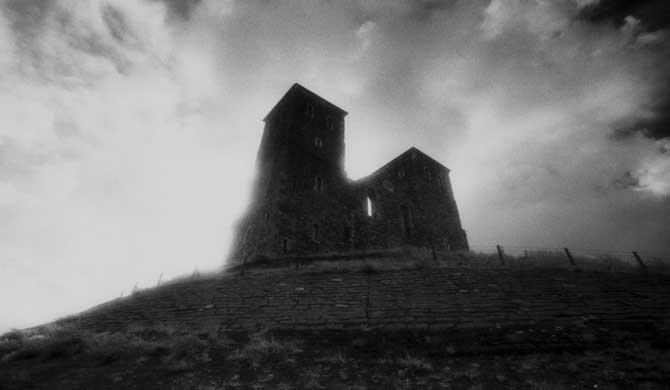
THE HOME COUNTIES. Bedfordshire. Berkshire. Buckinghamshire. Hertfordshire. BERKSHIRE. BUCKINGHAMSHIRE. HERTFORDSHIRE. Minsden Chapel. Hertfordshire. Hidden
from view by a wooded copse, and reached by a brisk walk along a muddy
bridleway, the St Peter’s Church. Tewin, Hertfordshire. Perched on
a slight incline, the squat church of flint and brick is not overly impressive.
It is ringed by a peaceful churchyard, where rests the body of a heretic whose
grave is surrounded by a wrought iron fence and whose heresy is remembered by
the bizarre fulfilment of a death bed prophesy. Her name was Lady Anne Grimston
and in life she was a staunch atheist. As she lay upon her deathbed, in November Her body was laid to rest in St Peter’s churchyard where, either by the hand of fate, or by the machinations of an opportunist clergyman several trees have indeed sprouted through her tomb, lifting it slightly and dumping great chunks of moss-clad masonry onto the carpet of nettle and bramble, beneath which her mortal remains now lie.
The A3. Burpham. Nr. Guildford. Surrey. On Wednesday December 11th 2002, Surrey Police received several calls from motorists to say that a car had veered off the A3 with its headlights blazing. But when officers arrived at the scene they could find no sign of a crashed vehicle, it appeared to have vanished without trace. A further search, however, was ordered - and the results were chilling. For, just twenty yards from the supposed "crash scene," police found the wreckage of a car containing the remains of a man, buried in twisted undergrowth. Its lights were off - the batterry had long since died - and the body was little more than a skeleton. Surrey Police later revealed that the crash had, in fact, happened in July 2002, and that the vehicle had lain undiscovered for close on five months. The motorists who had originally alerted the police were, therefore, left to ponder the eerie possibility that what they had seen was a ghostly re-enactment of the original accident.
The Ostrich Inn. Colnbrook, Berkshire. This atmospheric old inn stands in the ancient village of Colnbrook and was once an important stopover, on the main stagecoach route that ran from London to Bath. Not wishing to enter the fracas of the endless battle to proclaim itself the oldest pub in England, The Ostrich plays it safe and claims to be the “fourth oldest” and records of the inn certainly date as far back as 1165. One thing it can certainly claim, however, is that it was the first pub in England to ever be featured in a novel, Thomas of Reading, written in the late 16th century by Thomas Deloney. It was Deloney’s reporting of the nefarious exploits of a former landlord called Jarman that secured the Ostrich’s place in Berkshire legend. His infamous crimes are generally thought to have taken place at some time around the 1300’s. In those days, wealthy travellers would pause at the inn to change from their mud-spattered clothes, into the finery expected for their appearances before the monarch at nearby Windsor Castle. Many of these wayfarers would often carry vast sums of money with them, a fact that didn’t go unnoticed by Jarman who had soon devised a profitable and intricate method of relieving them of both their riches and their lives. Whenever a seemingly affluent patron arrived at his inn, Jarman would waste no time in plying the stranger with strong drink. Having arranged for these special guests to sleep in his “best room”, he would give them time to collapse into bed and, once he was sure that they were fast asleep, he would undo two bolts on the ceiling in the room beneath. This would cause their bed to tilt downwards at a 45 angle, sending the insensible sleeper tumbling into a vat of boiling fat, that Jarman always kept ready in the room below. He would then steal the person’s belongings; sell his horse and clothes to the unquestioning gypsies, and dispose of the body into the nearby river. He seems to have profited immensely from his activities and to have escaped any suspicion for many years. But then one night a suitably drunk stranger had crawled into the bed, when the amount of alcohol he had consumed, forced him to climb straight back out and make use of the rooms chamber pot. As he answered the call, he was astonished to see the head of his bed, suddenly tilt and disappear into the floor. His terrified shouts roused the other guests, and Jarman’s murderous career was over. On the gallows, he boasted of having killed more than sixty people, although the actual believed total is closer to fifteen. Staff at the inn, where a decidedly old world charm still holds sway, are often troubled by the “sinister atmosphere’s” that seem to hang over certain sections, and several landlords have complained of their night-times repose being rudely disturbed by the eerie sound of creaking boards, ghostly sighs and spectral bumps, that are simply attributed to one of Jarman’s long ago victims.
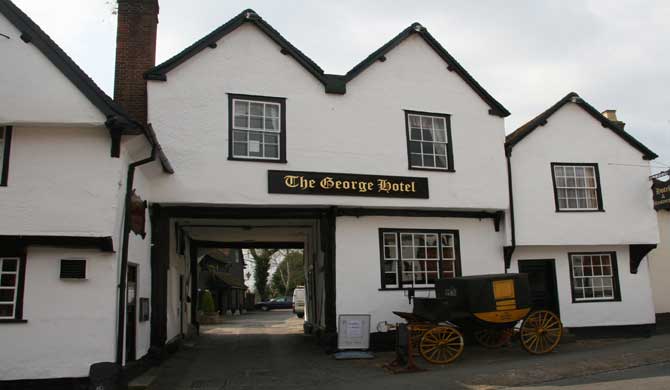
The George and Dragon Hotel
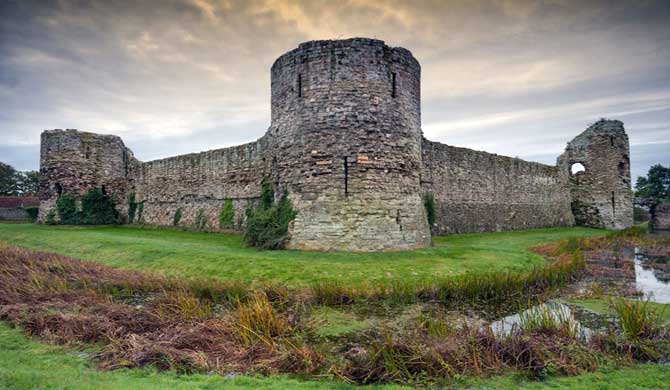
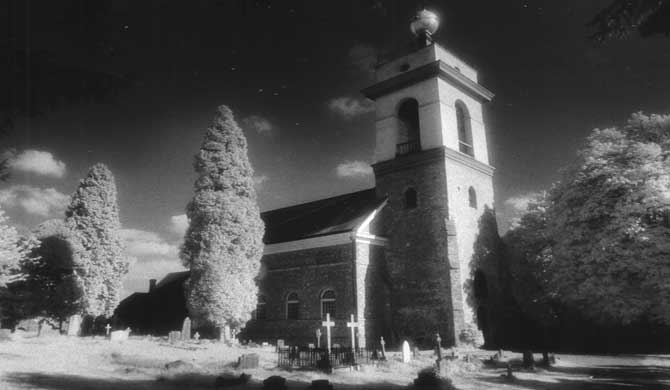
St Lawrence Church and The Dashwood Mausoleum. West Wycombe, Buckinghamshire. The Nefarious Goings On Of The Hell Fire Club. West Wycombe is a delightful, though tiny, village, comprised of a single high street of timber and flint buildings, on the outskirts of which sits the magnificent seat of the Dashwood family, the beautifully Palladian West Wycombe Park. On the summit of the steep conical hill across the road from the house, is the immense Dashwood Mausoleum, behind which towers the strange golden ball that sits uneasily atop the church of St Lawrence. Meanwhile, hewn out of the hillside beneath are a series of caves, reached via an entrance that has been fashioned to resemble a gothic church and which adds to the overall ambience of eccentricity with which the overall estate seems imbued. The person responsible for all this was Sir Francis Dashwood (1708-1781), a man whose name has become a byword for hedonistic debauchery, and who is today best remembered as a leading light in the most infamous of all the so-called “Hell Fire” clubs. These secret societies had become popular with wealthy young aristocrats in the first half of the 18th century and in 1721 it was considered to necessary to pass a Royal edict condemning “Young People who meet together in the most impious and blasphemous manner.. and corrupt the minds and morals of one another”. Ironically, Dashwood’s organisation, which is now perhaps the only one to be universally remembered, and which operated between the 1740’s and 1760’s, never actually called itself the ‘Hell-Fire-Club’, preferring instead to be known as the “Knights of St Francis”. John Wilkes (1725 – 1797), the radical politician, and an enthusiastic member, described their gatherings as “A set of worthy, jolly fellows, happy disciples of Venus and Bacchus, got together to celebrate women in wine”. The select central core of just thirteen “apostles”, led by Sir Francis Dashwood, included Lord Sandwich, John Wilkes, the painter William Hogarth, poets Charles Churchill, Robert Lloyd and Paul Whitehead, whilst American, Benjamin Franklin, was reputed to have been an occasional visitor. Although their early meetings probably took place at the homes of various members, including West Wycombe Park, Sir Francis began casting around for a base that would provide the necessary seclusion for the clubs activities. He settled on the ruins of the old Cistercian abbey at Medmenham, six miles from West Wycombe, which he restored to opulent splendour and inscribed above archway over the entrance the clubs motto Fay ce que voudras (Do as you wish). Thereafter the society would also be known as “The Monks of Medmenham”. Despite the fact that these self -styled monks certainly indulged in a goodly amount of sexual frolicking, and did include mock religious services in their rituals, there is no evidence to suggest that, as has been frequently claimed, they ever practiced Satanism. The rumour that they did, was probably begun by their enemies in the late 18th Century, and gathered momentum throughout the 19th and 20th Centuries. There is, however, a delightful, though spurious, tale that at one of the meetings, John Wilkes concealed a baboon, which he had dressed as the Devil, in a chest beneath his seat. At an appropriate moment, he jerked a cord which opened the chest and the creature jumped onto Lord Sandwiches shoulders who, believing that he had conjured up the Devil, cried out “Spare me gracious Devil: spare a wretch who never was sincerely your servant. I sinned only from vanity of being in the fashion; thou knowest I never have been half so wicked as I pretended: never have been able to commit the thousandth part of the vices which I boasted of…”. The animosity felt by Lord Sandwich for John Wilkes would lead him to pursue a vendetta against him that would see Wilkes expelled from the House of Commons and ultimately, lead to his being jailed for three years. At the height of the Wilkes scandal, Sandwich is supposed to have exclaimed at him, “Upon my soul Wilkes, I don’t know whether you’ll die upon the gallows or of the pox” “That depends, my lord,” replied Wilkes “on whether I first embrace your lordships principles or your lordships mistresses”. But their feud also dragged in other members, including Sir Francis himself and, by 1766, he had effectively disbanded the Knights of St Francis” and thereafter they would be nothing more than a vague, albeit infamous memory, around whom all manner of salacious gossip would gather. Holy Trinity Church. Weston. Hertfordshire. The Grave of JackO’Legs Close to the churches gateway, there stand two stones that mark the reputed grave of the fabled local giant, Jack O’Legs. He is said to have lived during the Middle Ages and was supposed to have been so tall that he could lean on first-floor window sills and chat with occupants inside the houses. He was also renowned for his prowess as an archer, possessing the ability to bring down a bird from half a mile away and to shoot an arrow for over three miles. But it was for his nefarious activities as a highway robber that he was best known and, like many an outlaw before and since, he was famed for robbing the rich to give to the poor. Indeed, he held up so many wealthy travellers on the old Great North Road, that a steep incline close to the village of Graveley is still called “Jack’s Hill” in commemoration. It was, however, the rich bakers in the market town of Baldock that, due to their practice of giving short measures, he was wont to harass the most. But, eventually, they grew tired of Jack’s charitable escapades at their expense, and banded together to rid themselves of him once and for all. One day, as he was striding through Baldock, he was hit from behind with a heavy pole. Having bound him in chains, the bakers dragged Jack to nearby Gibbet Hill, where they put out his eyes with a red-hot spit. Jack begged to be allowed to fire his bow one last time and asked that his body be buried where the arrow fell. The bakers consented to his final request and watched his arrow fly for two miles, before it struck the spire of Holy Trinity Church in Weston and fell into the churchyard. It was here that, following his execution, they laid him to rest tan marked his grave with the two ancient stones, twelve feet apart, which are still said to stand over the mortal remains of the legendary giant, Jack O’Legs. Donnington Castle. Nr Newbury. Berkshire. Donnington Castle’s towering gatehouse, standing on a high spur and overlooking the old London to Bath road, is an awesome edifice that still commands the attention much as it has done since its construction in 1386. Built by Richard de Abberbury, chamberlain to Richard 11’s Queen, Anne of Bohemia, its’ most eventful period was during the Civil War when Charles 1st seized it from its owner, John Packer, and appointed John Boys commander of the garrison. In July 1644 the Parliamentarian General Middleton arrived with 3000 men and demanded that the garrison surrender. When Boys refused, Middleton launched an ill-conceived siege that not only failed to break through the castle’s defences, but also cost him a tenth of his force. In September, a new force under a new commander loosed a twelve-day volley of cannon fire at the walls. Three of the castle’s flanking towers were blown to smithereens and the curtain wall was breeched, but still the valiant Boys refused to surrender. A month later the Parliamentarians tried again and bombarded the castle with more than a thousand shots. But when they sent word demanding that Boys submit, they received his customary short shrift. Then word arrived that Charles 1st was on his way to relieve the defenders and the attackers retreated. The exhausted garrison were duly re-provisioned and were able to enjoy a brief respite from hostilities. When the second Battle of Newbury on 28th October 1644, ended in stalemate, another assault on the Castle led by Sir William Waller ensued. Once more the demands for surrender were met with an emphatic “no” from the gallant Boys, and a week later a Royalist force commanded by Prince Rupert managed to relieve the garrison. Colonel Boys used the respite afforded by the winter months to strengthen his defences and was once more prepared to continue his valiant stand. But the Civil War was drawing to a close and when, in March 1646, the Parliamentarians again demanded his surrender, he sought the Kings instructions and was told to shift for himself and get the best terms he could. On the 1st April 1646 having withstood almost twenty months of constant siege, John Boys surrendered to his adversaries. Parliament then voted for the demolition of this symbol of valiant resistance, and today all that remains are the twin towers of the mighty gatehouse that rise from the grassy hillside to a commanding 65 feet. Needles to say, such a turbulent history has resulted in several ghosts. There are persistent reports of spectral white dog that comes bounding down the hill from the castle towards the woods below. The creature makes no sound and the first intimation that he is anything more than living flesh and blood, is when he suddenly vanishes into thin air. A ghostly guard has also been seen around the gatehouse. Whether he is the shade of one of the castle’s Civil War defenders is unknown, since he never stays around long enough for witnesses to ask him! One minute he’ll be standing by the gatehouse, a solid and apparently human figure, next he will suddenly disappear, as one witness put it, “like a bubble bursting”. The text on this page is the copyright 2004 of author Richard Jones. It may not be reproduced in any form whatsoever without the express permission of the copyright holder or of his publishers, New Holland Publishers Ltd. |