
THE GHOSTS AND LEGENDS
OF SCOTLAND
A variety of ghosts are to be found in the houses, castle, inns, moors, lochs and ruins of Haunted Scotland. Scotland has always been a divided nation and its history is spattered with the blood of countless conflicts, many of them fought between the Highlanders and the Lowlanders. Only very occasionally did the two sink their differences to unite against a common enemy, as successive English Kings strove to invade and conquer.
VESTIGES OF A STORMY PAST
Vestiges of Scotland's stormy past are to be found all over the country and nowhere is it more apparent than in the haunted, ruined castles of Scotland.
These ruined fortresses - silent reminders of old and bitter conflicts - stud the Scottish landscape.
From the gentle farmlands of the Central Lowlands to wild Empty lands of Europe's last great wilderness in the country's Northwest, Scotland's abandoned castles stand as sullen witnesses to centuries of conflict and bloodshed, and the ghosts that wander their timeworn corridors and historic rooms are perpetual reminders of a violent and stormy past.
Behind the sombre walls of these impressive bastions, Kings and Queens, Lairds and Ladies, Highlanders and Lowlanders, the famous and the long forgotten, continue to inhabit an ethereal domain where old feuds and differences have never died, and where dastardly deeds and ancient discords occasionally cross the centuries to baffle and astonish those who happen to stumble upon their ghostly re-enactments.
SCOTTISH HAUNTINGS
Hermitage Castle, Newcastleton, Borders
Hermitage Castle broods in desolate isolation amidst some of the eeriest countryside imaginable.
The gentle warmth of a summer’s day rarely penetrates its sullen bulk. Creepy corridors and cold stone staircases meander between the moss-clad walls of its ruinous interior the very fabrics of which seem imbued with a genuine ambience of menacing evil.
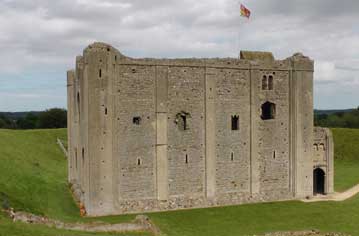
Built around 1300, on the disputed borderlands between England and Scotland, the castle’s ownership would switch regularly between the two over the next four hundred years, as the frequent conflicts that swirled around its towering walls led to its being dubbed the "guardhouse to the bloodiest valley in Britain."
One of the earliest owners of Hermitage Castle was Sir William Douglas "the Knight of Liddesdale" who wrested it from the clutches of its then occupant, the Englishman Sir Ralph de Neville in 1338.
Douglas was much respected in Scotland on account of his victories against the English. However, when King David 11 made Sir Alexander Ramsay sheriff of Teviotdale, the ruthless and envious Douglas lured the unfortunate Ramsay to Hermitage and imprisoned him in a "frightful pit or Dungeon, apparently airless and devoid of sanitation." Here he was starved to death, and his ghostly groans have echoed down the centuries ever since.
But most infamous of all the Castle’s bygone residents was Sir William de Soulis, who owned it during the reign of Robert the Bruce (1274-1329).
Historically, Sir William was arrested and executed for plotting the assassination of The Bruce in order that he might have himself crowned King of Scotland.
But legend has chosen to bestow a far more dramatic end upon "Bad Lord Soulis."
Tradition maintains that this thoroughly evil individual was a practitioner of the Black Arts who kidnapped the children of the neighbourhood to use their blood in his sinister rituals, during which he would conjure up his demonic familiar, Robin Redcap.
Eventually the local residents petitioned King Robert, begging to be relieved from the scourge of their wicked Lord. "Boil him if you must," replied the King "but let me hear no more of him."
Taking his words literally, the locals stormed the castle, wrapped de Soulis in lead, and plunged him head first into a boiling cauldron.
His ghost now wanders the castle, a malevolent spectre whose nebulous meanderings are often accompanied by the heart-rending sobs of children echoing along the crumbling corridors.
There is something strangely indefinable about Hermitage Castle, as though whatever malicious forces are harboured within its vast, impregnable walls resent your presence.
Indeed, it is easy to understand the local sentiments, recorded by Sir Walter Scott that "The Castle.. unable to support the load of iniquity which had long been accumulating within its walls, is supposed to have partly sunk beneath the ground; and its ruins are still regarded by the peasants with peculiar aversion and horror."
Blackness Castle
Blackness, Falkirk
Your worst nightmare’s could not conjure up a place as demonic as the aptly named, Blackness Castle.
It squats menacingly atop a knoll of jagged black rock, its shoreline lapped by the grey waters of the Firth of Forth.
From the moment you set foot on the rickety pathway of its dark, vaulted gatehouse, you are confronted by a sparse interior, where evil foreboding oozes from its every pore.
As you wander between its forbidding towers, you don’t so much walk as stumble across the uneven cobblestones or scramble across chunks of black, serrated rock to reach rooms and staircases where you can just sense that numerous unspeakable deeds have been perpetrated.
Built in the 14th century, and massively strengthened in the 16th century when it became an artillery fortress, it has also been a Royal Castle, an armaments depot and a State prison.
The central Tower is known as the "Prison Tower" and, as you climb its winding stone staircase, a distinct feeling of oppressive coldness hangs heavy in the air.
It was here that a dramatic manifestation occurred in the late 1990’s, when a lady who had brought her two young sons on a visit, was startled by the sudden appearance of a knight in armour whom, she claimed, chased her angrily from the tower.
A group of ghost enthusiasts, who persuaded the custodian to allow them to stay over night one Halloween, were disturbed by the constant noise of furniture being scraped and banged across the stone floor of the room beneath them. Although one of their number bravely investigated the disturbance, he found nothing out of place. But the moment he returned to his companions, the noises began again.
Mary King’s Close, Edinburgh
Standing in the dark, narrow Close’s and Wynds that slope steeply between the tall gaunt buildings that line the ridge known as the Royal Mile, in Edinburgh, you find yourself lost in an almost ethereal world of silent shadow.
In the Middle Ages this was one of the most densely populated and disease ridden quarters in Europe, and you entered these sinister labyrinths at your peril. Confined by the city wall, Edinburgh had expanded upwards, its stark tenements rising nine, ten - even eleven storeys high, casting the walkways between them into eternal darkness.
Even today a journey through these murky chasms is not for the faint of heart, and the tales of ghosts and sinister happenings, of which there are plenty, can elicit cold shivers, even on the brightest summers day.
Buried beneath the 18th century buildings of the city chambers, there exists a hidden Close that is, historically more horrifying, and supernaturally more terrifying than any other – Mary King’s Close.
Plague was a frequent visitor to the squalid and rat infested tenements of Edinburgh. But one of the worst visitations came in 1645 and the residents of Mary King's close were decimated by it.
The City fathers, in an ill-conceived and barbaric attempt to contain the contagion walled these neighbourhood's off and left the residents to die in what must have been unimaginable horror.
Once the pestilence had abated, the stench from the corpses became unbearable, and so the authorities sent two butchers to clear away the detritus of the deceased. The men simply hacked the rotting cadavers to pieces, loaded them onto a cart and wheeled them away.
Such was the shortage of accommodation that soon new residents came to live in Mary King’s Close and, by 1685, it had become common knowledge that spirits from the plague year were still there!
Thomas Coltheart, a lawyer, and his wife were beset in their new home by numerous apparitions.
The disembodied head of an old man, with a grey wispy beard and terrible eyes was seen floating around their rooms. It was sometimes accompanied by a severed arm, which seemed intent on shaking Thomas Coltheart’s hand.
A ghostly child appeared hovering in mid air and a veritable menagerie of strange, deformed phantom animals paraded before the astonished couple.
The upper storeys of the Close were demolished in 1750 and the Royal Exchange constructed on the site.
The City merchants, however, preferred to do business in the streets and so the new building became the City Cambers, beneath which the rooms, passages and stairways of Mary King’s Close survived. Today it is a secret place that can be visited only on pre-booked tours, but it also reputed to be the most haunted part of Edinburgh.
A tall lady, dressed in a long black gown, is but one of the many ghosts that frequent this underground world of lengthening shadows. Several visitors have caught fleeting glimpses of a short, elderly man who wears a troubled expression.
But perhaps the most poignant of its earth bound spirits is that of a little girl, whose lank hair hangs over a pale face that is covered in weeping sores. She was discovered by a Japanese medium, brought here by a television company and who was told nothing of the Close’s history prior to her visit.
Stepping into one of the rooms the medium was overwhelmed by a disturbingly depressive aura. As she turned to leave, someone tugged on her trouser leg. Going back into the room she found a dishevelled young girl weeping in the corner, who told her that she had died of “the sickness” in 1645.
The distraught child revealed that she had lost her doll and felt very lonely and unhappy as a result. Moved by her plight, the television crew bought her a doll and left it in the room.
Ever since, many visitors have also brought gifts for the ghostly child, and a bizarre collection of toys, dolls, books and even coins are now piled in the corner of the room.
Balgonie Castle
Nr. Glenrothes, Fife
The magnificent sandstone residence of Raymond Morris, the much-honoured Laird of Balgonie, is one of the finest 14th century towers in Scotland.
Probably built by Sir Thomas Sibbald, Lord High Treasurer of Scotland, it was added to and expanded over the centuries until David, 3rd Earl of Leven, built the final wing in 1702.Despite playing host to several visitors of note – Mary, Queen of Scots, Rob Roy, Daniel Defoe, James Boswell and Dr Johnson included – the castle lay largely neglected by the 1840’s, and letters began appearing in the Edinburgh press decrying its appalling state.
The roofs’ being removed so that the owners could avoid paying the Roof Tax certainly didn’t help!
Throughout the 20th century vandals and the elements abetted the castles sad decline and, by the 1970’s, it was little more than a melancholic ruin.
In 1985 Raymond Morris, whose family were the first people to live in it for 160 years, purchased Balgonie Castle.
They had soon grown used to sharing their abode with the ethereal inhabitants to whom a fortress of such impressive antiquity is, inevitably, home.
The Laird’s son, Stuart, has seen a ghostly old man walking across the courtyard; a head and collar materialise out of a wall and front of him, and even a phantom dog and its nebulous owner who disappeared into an invisible doorway.
One night, Margaret, The Lady of Balgonie, was asleep by the fire in towers upper room (the wind often howls in demented fury around the walls and windows up here and there is no central heating!), when she awoke to find the figure of a man in 17th century attire, sitting on the sofa opposite. She looked him up and down and then he suddenly vanished.
A few weeks later, she came across a portrait of the first Earl of Leven, and immediately recognised him as the revenant she had seen.
But the castle’s most famous spectre is "Green Jeanie," described in 1842 as being a "well-known phantom."
Garbed in green, her face concealed by a hood, she wanders Balgonie castle and has been seen many times in recent years.
Nobody knows who she was or, even what event, if any, made her such permanent fixture in the castles phantom guest book. She has been seen walking behind the iron bars of the ground floor windows in the ruinous 1702 wing and was recently captured on a digital photograph, taken by a guest at one of the many weddings now held at the castle.
The Great Hall, which is the only room never to have been remodelled, still retains many of its original fixtures, and is imbued with a uniquely historic atmosphere chilling yet tranquil. It is a candlelit place of dancing shadows, where reports of indistinct shapes seen flitting around its darker recesses, or the oft heard sound of disembodied voices engaged in indecipherable conversation, are sufficient to send uncanny shivers down the spine.
Add to all this, several cold spots detected by visiting mediums; an unknown "something" that once ran its icy cold fingers down the back of an astonished waitress; a disembodied head that once floated out of the great hall; not to mention white and grey figures seen at several different locations, and you begin to understand why Balgonie has the reputation of being one of the most haunted castles in Scotland.
Yet, it is also a very spiritual and peaceful location, and the romantic chapel, bedecked in flowers, and illuminated only by candlelight, is acknowledged as a truly romantic wedding venue.
The whole castle, cut off from the outside world by a huge encircling wall, seems trapped in a time warp, and exploring it in in the company of the kilted and bearded Laird is an experience without equal.
Raymond Morris readily acknowledges the presence of at least nine ghosts at his home, but insists that none of them is malevolent. "They’re like part of the family," he observes, "they were here first, I just hope they’re pleased with what we’re doing here now."
Abbey Craig, Stirlingshire
William Wallace, Braveheart!
On 10th September 1297, William Wallace stood upon the lofty heights of Abbey Craig - where Scotland’s national memorial to him now stands - and gazed across the River Forth at the English held stronghold of Stirling Castle.
The second son of minor Scottish noble Malcolm Wallace, William had grown up against the background of war, intrigue and ruthless oppression that had seen Scotland’s King, John Balliol, stripped of his sovereignty by England’s Edward 1st and his country bowed to English rule, her independence sacrificed to the self serving interests of her bickering and duplicitous nobles.
It had been the death in 1286 of Scotland’s King Alexander 111, that set in motion a chain of events that would bring Scotland into open conflict with Edward 1st of England and, ultimately, start Wallace on his path of outlawry, freedom fighting, martyrdom and immortality.
Under Alexander’s rule the Scots had enjoyed twenty years of peace, both at home and abroad, and were basking in a period of prosperity buoyed up by a thriving export trade.
In 1284 the King had named as his successor to the Scottish throne his granddaughter, Margaret, (‘The Maid of Norway’).
Furthermore a treaty had been agreed with the King of England, whereby Margaret would marry Edward’s five- year- old son, Edward of Caernarfon, and join the two dynasties, albeit on the binding agreement that Scotland would remain an independent state.
Thus, with one act of union, peace and prosperity could be maintained while Edwards ambition to unite the two countries could be satisfied.
Sadly, it was not to be, for Margaret died en route from Norway and a fierce debate as to a successor ensued.
John Balliol and Robert Bruce (grandfather of the future King) emerged as the strongest of the fourteen contenders, but their rivalry threatened to plunge Scotland into a bloody civil war.
So it was that the Scottish nobles turned to Edward 1st of England and asked him to mediate in the contest.
In May 1291 Edward invited them all to a meeting at Berwick, where he demanded that, before any discussion could begin, all those present must recognise him as Scotland’s Overlord and surrender all Scottish Castles into his hands until after the succession had been agreed.
On 13th June 1291, led by Robert Bruce and John Balliol, the Guardians and Lords of Scotland lined up to place their hands in Edward’s and, one by one, surrendered their nations independence by recognising him as "superior and direct lord of the Kingdom of Scotland."
Shortly afterwards the accession was settled in favour of John Balliol who was duly inaugurated at Scone.
It was Edward’s insistence that, as Overlord, he had the ultimate authority to hear appeals from Scots against their Kings judgements that edged the two nations into disagreement.
But it was his summoning of King John in 1294 to join his war against France that turned the disagreement into open conflict.
In 1295 the Scots cemented an alliance with Phillip 1V of France and effectively declared war on England. It was a brave move but a monumental miscalculation. Edward, at almost sixty years of age, with his flowing mane of white hair was the veteran of many military campaigns – a warlord without peer.
He mustered an army of 25,000 foot soldiers and almost a thousand knights and marched on Berwick, then the richest and most populous city in Scotland.
His objective was to teach the rest of Scotland what to expect if they continued to resist. In so doing he subjected the unfortunate citizens of Berwick to a horrific three day massacre that left 11,000 men, women and children dead and their blood, so one chronicler lamented, streaming "so copiously that mills could be turned by its flow."
Edward’s army then swept northwards, inflicting a crushing defeat on Balliol’s army at the battle of Dunbar and capturing the ancient coronation stone, the Stone of Destiny, which was taken from Scone to Westminster Abbey.
One by one the Scottish nobles surrendered to Edward.
Then in July, at Kincardine Castle, King John himself was forced to confess his rebellion and resign the throne, his humiliation compounded by Edwards ripping the Royal insignia from the chest of his Tabard.
When the great seal of Scotland, that most precious emblem of Scottish Sovereignty, was presented to Edward, he cast it contemptuously aside, observing facetiously that "a man does good business when he rids himself of a turd."
Edward wasted little time in inflicting English administration upon the vanquished Scots and placed her affairs into the hands of two trusty lieutenants, William de Warenne and treasurer Hugh Cressingham.
He then ordered every freeholder in Scotland to swear and oath of fealty to their conqueror. Most did, but amongst those who steadfastly refused were Malcolm Wallace and his brother, William.
Their father, Malcolm, had refused to swear a similar oath in 1291 and had later been killed in a skirmish with the English.
By 1296 William had acquired something of a reputation as an anti-English firebrand who had avenged the death of his father by killing his slayer, an English Knight named Fenwick.
He was considered a giant of a man, standing at over 6 feet tall and had become a sort of Robin Hood figure, leading a band of outlaws whose hideout was situated deep within Ettrick forest.
On the forest periphery stood the town of Lanark where lived a beautiful young heiress called Marion Braidfute to whom Wallace was, if not married, then certainly betrothed.
When the Sheriff of Lanark, Hazelrig, had Marion’s brother put to death Wallace and his comrades stole into town and put fifty English soldiers to the sword.
Hazlerig meted out savage retribution by executing Marion "to deny Wallace of the woman he truly loved."
Wallace returned to the town, murdered the sheriff in his bed, killed his son along with two hundred and forty English soldiers, merchants and commoners, before going on the run, rampaging his way across Scotland collecting fables and followers as he went.
Thousands flocked to his cause, including many nobles, chief amongst them the younger Earl of Carrick, Robert Bruce who was destined to continue the fight after Wallace’s death and, having freed his nation from English rule, would become one of Scotland’s greatest kings.
When the Scottish Bishop’s gave their blessing to the rebellion it became both a national and moral crusade.
By the time he arrived at Abbey Craig, his army had swollen to over 40,000 men, and Wallace himself had become the ultimate cliché of patriotic resistance – a living legend.
From Stirling Castle itself the English commander, William de Warrenne, watched the rebels assemble. With 50,000 seasoned and heavily armed soldiers under him, he was confident that the ill disciplined, lightly armed Scottish force would be no match for his superior army.
But, observing battle protocol, he sent two Dominican friars to offer a reprieve for all past misdemeanours if Wallace and his comrades would surrender. "Tell your commander that we are here not to make peace but to do battle, to defend ourselves," was Wallace’s contemptuous reply. "Let them come on and we shall prove this in their very beards."
On the morning of 12th September 1297, the English cavalry began to file across the narrow, wooden bridge that spanned the River Forth.
From their vantage point on Abbey Craig Wallace and his comrades watched as the superior force began to fan out onto the marshy ground below.
At 11am William Wallace raised his battle horn to his lips and, blowing a long loud blast, gave the signal to attack. The English were caught completely off guard as an avalanche of screaming terror came hurtling towards them and plunged into their ranks, swords and spears at the ready.
A detachment of rebels broke from the main force and hacked and stabbed their way to the bridgehead determined to secure it.
Panic-stricken, the English troops were unable to proceed but found their retreat blocked by their own advancing company. Many fell or jumped into the river where, weighed down by their armour and equipment, they drowned in its deep waters.
Others were either cut down by rebel swords, impaled by Scottish spears, or else were crushed to death beneath horses hooves and men’s feet.
By afternoon, the greatly outnumbered Scottish force had inflicted a crushing rout on an English army that, until then, had never known defeat.
Plundering the bodies of their vanquished enemies, the victorious Scots came across that of the hated English Treasurer, Hugh Cressingham. They promptly flayed the skin from his corpse and fashioned it into a belt for Wallace’s sword.
Wallace was a national hero as he moved on to capture Dundee and drive the English forces further and further south until, by October 1297, not one English soldier remained in Scotland.
But as they retreated, the English adopted a scorched earth policy, burning farms, slaughtering livestock and destroying crops.
With the onset of winter and the people of Scotland facing famine, Wallace crossed the border and ravaged northern England. In so doing his reputation for savagery became well and truly cemented in the English consciousness.
It was not all battles, however, he issued a letter to Lubeck and Hamburg declaring that Scotland was free and that trade could resume between the countries.
Wallace was knighted and declared the Guardian of the Realm, acting for John Balliol.
But, as is so often the case in Scottish history, victory was short lived. The following year Edward 1st mustered a huge fighting force and, on 12th July 1298, he routed the Scots at Falkirk.
The rebellion was over and, although he managed to escape from the battlefield, William Wallace renounced his guardianship of Scotland and faded into obscurity.
It is known that he went to France in 1298 or 1299, probably to ask for military or diplomatic help. He may also have gone to Rome for the same reasons. It is highly probable that he returned to his campaign of guerrilla warfare and remained a considerable thorn in England’s side.
But history remains mute about his activities until in 1305, betrayed by one of his own countrymen, he was captured and taken to London.
There, in the imposing surrounds of Westminster Hall, he was sat on a bench and laurel crown was placed upon his head.
When the Kings Justiciar accused him of treason, Wallace refused to answer the charge, pointing out that since he had never sworn allegiance to Edward 1st he couldn’t be guilty of treason against him.
The English, however, were not interested in such legal niceties and the result of the trial was a foregone conclusion.
Thus it was that on August 23rd 1305, tied to the tails of two horses, William Wallace was dragged through the streets of London to suffer the barbaric punishment of being hanged, drawn and quartered.
Dalzell House
Nr. Motherwell, Lanarkshire
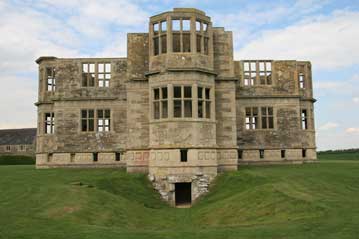
Nestling in a well-wooded park Dalzell House is one of the finest mansions of the Scottish Lowlands and boasts an impressive pedigree that stretches right back into the foggy mists of time.
The present structure is an eclectic mix of buildings that cluster around a largely complete 15th century fortified tower house that remembers days of bloodshed and warfare.
Originally the home of the Dalzell Earls of Carnforth they kept possession of the estate form the 13th to the 17th centuries, when the then Earl, Robert, was found guilty of treason and sentenced to be death.
The sentence, however, was commuted and instead he was stripped of rank, titles and lands and fined 100,000 Scots merks.
The Earldom and estates passed to his son, Gavin, who in 1649 sold the house to the Hamiltons of Boggs, to pay his father's fine.
In 1886 John Glencairn Carter Hamilton was created the first Baron Hamilton of Dalzell and the house hosted many Royal visits, with at least five of Queen Victoria’s children dropping by to enjoy its hospitality.
William Ewart Gladstone was also a visitor and in the grounds there is still a small round building known as 'Gladstone's Tearoom' in commemoration of his time here.
Although the house itself is private, the grounds that surround it are open to the public and from there you can gaze upon its sturdy walls and ponder the ghosts of the green, grey, and white ladies that are said to wander the house‘s interior.
The green lady is a spectral fixture of the houses South Wing and her ghostly wanderings are often accompanied by the distinct scent of sweet perfume.
The grey lady favours the North Wing and may well be the ghost of a nurse from the days when it was used as a hospital during the First World War.
The white lady is, apparently, of no fixed abode and can suddenly appear unannounced at sundry locations around the property.
One tradition holds that she is the shade of a former maidservant, who having become pregnant was so overcome by despair that she threw herself to her death from the battlements.
Another story maintains that she was in fact bricked up somewhere in the house’s fabric as punishment for some long forgotten indiscretion and it is this that has caused her spirit to roam the night hours of the old house.
People walking in the park at dusk have reported the unnerving sensation of being watched by invisible eyes and some have even caught glimpses of a forlorn female gazing at them from the windows of the house, although her form is not distinctive enough for them to be sure of the hue of their phantom observer.
Traquair House
Nr. Innerleithan, Borders
The dazzling white walls of Traquair House rise majestically from the rolling countryside that surrounds it and to cross its threshold is to find yourself wandering through passages and corridors where time stands still.
Ancestral portraits gaze down from timeworn walls. Stone stairwells spiral upwards to meandering corridors where with each step you find yourself falling under the spell of a house that has enjoyed continuous habitation for longer than any other in Scotland, and which claims to have played host to no fewer than twenty-seven Scottish monarchs.
Mary Queen of Scots came here with Lord Darnley in 1566, and the cradle in which their infant (later James V1 and 1st) slept is still on show in the room that they occupied. Bonnie Prince Charlie arrived during his 1745 campaign to reclaim the throne.
At the time hopes of success were running high, and as the Prince left the house through the Bear Gates - so called because of the two stone bears that surmount the sturdy gate posts - the fifth Earl of Traquair, locked them behind him and vowed that they would not be opened until a Stewart once more sat upon the throne.
When hopes for a Stewart restoration were dashed in the blood-spattered carnage of Culloden Moor, the gates remained locked, and today’s visitors approach the house via a driveway that bypasses the Bear Gates.
Given its tumultuous and emotional past, ghosts are conspicuous by their absence in the house’s interior. However the solemn wraith of at least one former resident has been seen wandering the grounds.
A portrait of Lady Louisa Stewart, sister of the 9th Earl of Traquair, and the last Stewart lady to live there, can be seen inside the house. She died in 1896 a few months short of her 100th birthday.
Perhaps it was the disappointment at not reaching her centenary that brought her ghost back in the early years of the 20th century?
One day a grounds man was ploughing in the fields when he saw a lady in old-fashioned clothing come drifting towards him. He watched in astonishment as she walked by him, passed effortlessly through a closed gate into the wood beyond and disappeared. He was later able to identify the fabric of the dress that his ghostly visitor was wearing from a book of fabrics shown to him by a woman who had been Lady Louisa’s dressmaker.
GHOSTS OF THE HIGHLANDS
Ravenswood House
Ballater, Aberdeenshire
Wandering around the cosy interior of Ravenswood House, you might chance upon a bearded figure, wearing an Arran sweater, the arms of which are rolled up to the elbows to reveal an old fashioned long-sleeved vest. You might bid him "good day," or words to that effect, and you might even be tempted to exchange a few pleasantries.
What you might not realise is that you have met one of the two resident ghosts that wander the cosy and little changed interior of this delightful hotel.
Ravenswood is also the proud possessor of a fully functional Victorian lavatory, now used as the ladies toilet, the solidness and bulk of which is as impressive as it is fascinating!
It is presumed that he is the ghost of the houses builder and original owner, a seafaring man who erected the property in 1820.
Since his cargoes consisted largely of tea and alcohol, for some reason a clause was inserted into the lease that forbade the house to sell either alcohol or tea.
Such a ban presented few problems whilst the building remained a family home.
But in 1970, the house became a hotel and the new proprietors set about overturning the restrictive clause.
The ban on the sale of alcohol was lifted. But the one on tea was not. Thus the current owners, Scott and Cathy Fyfe will happily sell their guests the cup, spoon, water and milk, but the accompanying tea bag is free!
But to return to the ghostly mariner. His roving shade has been encountered by many guests and all have commented on how solid and real he looks. Indeed many of them have not even realised his true nature until they have asked Scott or Cathy who he is and are told that they have been honoured with a sighting of the house’s ghost.
Ravenswood’s other ghostly inhabitant is a spectral nanny who only becomes active when small children come to stay. She has never actually been seen, but babies sleeping in cots have been heard over the monitoring intercoms gurgling and calling "nanny" to some unseen presence. When adults go to investigate they often find the child staring at someone that it can apparently see but which adults cannot.
On some occasions laughing babies have even pointed to their feet as if their ghostly supervisor is tickling them there!
No-one finds her antics in the least bit frightening and all who have encountered her have commented that it feels as though her sole intention is to watch over children who come to stay and to ensure that no harm befalls them.
The Prince’s House Hotel
Glennfinnan, Fort William, Inverness-shire
Set against a stunning backcloth of moody hills, the Prince’s House dates back to 1658 when it started life as a "change house" providing shelter and fresh horses for travellers traversing "The Road to the Isles."
It stands close to the spot where Bonnie Prince Charlie raised his standard in 1745, an act that signalled the start of the Jacobite uprising.
Although there are no records of the Prince ever staying here, there are suggestions that he may well have dropped in for a "wee dram."
By the 1840’s the "Stage House," as the building was then known, had become a notable coaching halt for Victorian travellers.
Its keeper had even achieved a modicum of fame as the tallest man in Scotland, although there is some debate as to his exact stature - six feet seven according to one account, seven feet six according to another! It is, of course, inevitable that some of those who have crossed the threshold of this delightful white-walled house, have chosen not to leave, and at least two ghosts are known to haunt it.
One is a grey lady who in the past appears to have been sighted regularly on the stairs, although the current proprietors, Kieron and Ina Kelly have yet to make her acquaintance.
The other is the ghost of a bearded highlander who occasionally wanders the building, bothering nobody as he keeps to a well honed routine that he no doubt established in life and is loathe to give up in death.
Spynie Palace
Nr. Elgin, Moray
For over five hundred years Spynie Palace was the seat of the Bishops of Moray, and its hollow shell looks back at past ages of grandeur and glory, whilst the mark of history is blazoned across its time-scarred walls.
It nestles in quiet seclusion, almost lost amidst tranquil countryside, and to delve into its rambling ruins is to walk in the footsteps of Kings and Queens, not to mention a rich array of historical and legendary figures from Scotland’s past.
One of the more infamous of its residents was Alexander Stewart, Earl of Buchan, whose mob of "wyld wykkd Heland-men" torched the town of Elgin in 1390 and burnt its Cathedral.
Whether Spynie Palace suffered damage at this time is not known, but Alexander Stewart - known to history as the ‘Wolf of Badenoch’ - was later appointed keeper of the Palace by King Robert 111, following the death of the then Bishop in 1397.
Although his tenure was no more than a year, he appears to have found its allure irresistible, and his sinister spectre has been seen many times leaning on a railing on the first floor landing of David’s Tower, gazing down on witnesses with seemingly wicked intent.
Its is within and around the unyielding bulk of David’s Tower (named for Bishop David Stewart who began its construction in the 15th century) that much of Spynie Palace’s paranormal activity is centred.
Visitors approaching it have caught glimpses of a hazy face gazing at them from its upper storeys.
Once inside you find yourself almost overwhelmed by the vastness of the stone walls that soar six storeys above you.
The inner walls and vaults have long since collapsed leaving a gaunt shell to whose sides a tenacious covering of dull plaster clings defiantly.
Mysterious rooms and dark recesses are set into the tower’s east wall and here a veritable cornucopia of phantoms and presences are known to lurk.
Many visitors have reported sighting a ghostly woman sitting in an arched niche to the tower’s right side as they enter.
Trudging up to the next floor and traipsing along the narrow stone corridor some people have been overcome by a nauseous feeling accompanied by a headache.
However, is all they have to do is politely say ‘excuse me,’ step to one side and the feeling quickly passes, as the unseen entity responsible simply moves on by.
More disturbing is the column of white mist, human in size, that has been known to materialise in mid air and drift briskly towards astonished witnesses.
On one occasion this unnerving phenomenon succeeded in knocking a startled sceptic to the ground as it swept over him!
A mysterious phantom skull often appears on photographs taken inside the tower, as does the indistinct form of a ghostly lion, said to be the revenant of a pet once owned by one of the Bishop’s.
Spynie Palace is one of Scotland’s eeriest and most haunted buildings, yet it possesses an atmosphere that both captivates and engrosses.
Its history is fascinating, its location enchanting, and its ambience is greatly enhanced by the chance of an encounter with a resident wraith.
Leith Hall
Huntly, Aberdeenshire
Leith Hall enjoys a lovely location amidst peaceful and rolling countryside. It is a squat, grey building resplendent with round towers and an abundance of chimneys.
Although owned by the National Trust for Scotland it possesses the intimate feel of a family home, due largely to the fact that for over three hundred years, from its construction in the mid 17th century to its handing over to the Trust in 1945, it was owned and lived in by successive generations of just one family, the Leiths.
Following the tragic death of the last laird in a motor cycle accident in 1939, his mother set about researching the lives and histories of the Leith ancestors, and although stating that "there is no haunting” she did acknowledge that "some of [the family] come out of the shadows into clear light and live and speak.."
One former family member who most certainly does haunt the house is John Leith, the 3rd Laird.
At the age of twenty five he married Hariott Steuart of Auchlunchart, and set about turning Leith Hall into a suitable family home. She bore him three sons and was pregnant with a fourth when, just before Christmas 1763, John rode to Aberdeen to dine with friends. Copious amounts of alcohol flowed at the meal and John reacted angrily when one of the diners accused him of adulterating the grain sold from Leith Hall.
There is confusion as what happened next. Either John challenged his detractor to a duel or else his accuser simply shot him in cold blood.
Whichever, on Christmas day 1736 John Leith died from the head wound he received from his adversaries pistol, and his widow was left to run the estate as best she could.
The tragedy appears to have left an indelible stain on the psychic fabric of Leith Hall and his ghost has been both sensed and seen at several locations.
In 1968, guests who were sleeping in the master bedroom reported that they found its atmosphere somewhat unsettling. There discomfort was not helped by the fact that in the early hours of one morning, the wife awoke to find a man in highland dress, his head swathed in bloody bandages, standing at the foot of the bed. She later commented that he bore an uncanny resemblance to the portrait of John Leith that hangs elsewhere in the house.
A female ghost of unknown identity but dressed in the garb of the 18th century has also been seen about the property, whilst ghostly footsteps, slamming doors have also been known to shatter the silence of the night hours.
It would seem that the ghosts of those to whom this lovely old house has been home are still active about the property, and there are certainly parts of it where you can sense them gazing at you across the centuries, telling you in no uncertain terms that this is their house, and although you are welcome, you visit it strictly on their terms.
The Well of the Seven Heads
Loch Oich
As you drive along the road that skirts the shore of Loch Oich you pass a bizarre column, surmounted by seven severed stone heads, that has a particularly gory history.
It all began on 25th September, 1663 when Alexander MacDonald, the young Chief of Keppoch and his brother Ranald, were stabbed to death by rivals within their clan.
Nothing was done to avenge their deaths until Iain Lorn, the Keppoch Bard, nagged MacDonald of Glengarry and Sir James MacDonald of Sleat to punish the criminals.
Two years later, the Privy Council in Edinburgh issued letters of "Fire and Sword" against the murderers. Another member of the Keppoch family, Ian Lom (Bald John), with the help of the MacDonalds of Sleat sought "ample and summary vengeance" for the murders by killing and decapitating the seven murderers.
It is said that on his way to Invergarry castle, to present the heads to the chief of Clan MacDonald of Glengarry, Lom stopped at the spring to wash the heads to make them more presentable.
Ever since then the spring has been known as Tobar nan Ceann, the Gaelic for Well of the Heads. Later, the heads were sent to Edinburgh and ordered to be "...affixit to the gallowes standing on the Gallowlie between Edinburgh and Leith."
The bodies were said to be buried in a nearby mound and have since been exhumed, thus providing evidence for the truth of the story.
In 1812, the then chief of the Clan McDonell ordered the construction of the roadside obelisk to commemorate both the crime and the summary justice meted out to the perpetrators.
Sitting atop the column is a sculpture of a hand holding a large dagger and around it are seven severed heads.
Although the well is most certainly not a holy well, it is interesting because the legend has parallels with the Celtic Cult of head and water worship, whereby the head was taken as a trophy of success over a vanquished enemy. It also seems to show a continuation of the belief of the supposed magical properties of the severed head and water, a common in thread in ancient mystical beliefs.
That aside the well itself is neither picturesque nor particularly mysterious. You enter its chamber by a long tunnel that is somewhat claustrophobic and which photographer, John Mason, summed up perfectly when he stated that "its smells like death."
Meldrum House
Old Meldrum, Grampian
The history steeped walls of Meldrum House sit peaceably amidst glorious surroundings of woodland and parkland.
Reached via a long drive that meanders past an 18 hole golf course, the house itself is a sprawling baronial mansion that sports impressive round towers and exquisite chimney stacks.
Its origins go back to the 13th century, although considerable additions and renovations were carried out in the 17th, 19th and 20th centuries respectively.
The house’s oldest resident is the mysterious white lady. She is believed to be the ghost of Isabella Douglas whose portrait hangs above the fire place in the hotel’s cosy reception area. Women in particular are susceptible to her spectral attentions and several housekeepers have reported feeling their apron strings being tugged by her invisible hand.
Her shade has frequently been seen around the hotel and she often appears when the air is heavy with thunder. Indeed in 1985, during a raging thunderstorm she gave a male guest quite a shock when she suddenly appeared from nowhere and planted a cold kiss upon his cheek!
At other times staff can actually tell whether she has happy or agitated by the way in which her phantom moves around. If she is content she walks slowly, but should she be discontented she will glide around premises, chilling the blood of any who encounter her. She seems to have settled down considerably since her portrait was moved from elsewhere in the hotel to its current over the fire location.
Maybe it’s because she is now able to greet guests as they enter her house, but as one member of staff told me "she’s been a lot happier since the move."
Finally, should a male guest who is even remotely descended from either the Meldrum, Seton or Urquhart families - the three dynasties with whom the house’s history is most indelibly linked - is placed in room three, he can look forward to being woken in the night by the alarming sensation of an invisible female scratching his chest. Staff confess that they are at a loss as to whether or not the ghost of Isabella Douglas is actually responsible for this!
The Pass of Killiecrankie,
Nr Pitlochry, Perthshire
Killiecrankie, a name derived from Gaelic and meaning "wood of aspens," is a tranquil oasis, set amidst dramatic and spectacular scenery.
The distant views of moody-grey mountains; the foaming waters of the River Garry, tumbling between steeply wooded cliffs; and the picturesque pathways, that twist their way through the dense undergrowth, all combine to lend the gorge a soothing aura of peaceful detachment.
But scattered about its tree-lined tracks, are numerous reminders of a long ago sunset, when the sudden sound of gunfire shattered the stillness, and a bloody battle exploded across the sylvan slopes of the ravine.
The Battle of Killiecrankie took place on 27th July 1689. It was fought between three thousand four hundred government troops, loyal to William of Orange, led by General Mackay, and two thousand five hundred Jacobite highlanders, supporters of the deposed King, James V11 of Scotland (James 11 of England), commanded by Viscount John Graham of Claverhouse, better known as "Bonnie Dundee."
As the opposing armies faced each other amidst the woodlands of Killiecrankie, the smaller Jacobite force claimed the higher ground and waited for the sun to move behind them, before Dundee gave the order to charge.
Dazzled by the sun, the government troops watched helplessly as a screaming avalanche of tartan terror swept down the slopes of the gorge towards them.
As the Royalist soldiers scattered, the ferocious Highlanders threw down their muskets and continued the fray with the flash of cold steel.
A government soldier named Donald Macbear, took one look at the advancing hoard and, pursued by a gaggle of deadly highlanders, ran for his life. Arriving at the rocky shore of the River Garry, he escaped by jumping 18 feet to its opposite bank, leaving his pursuers gazing in astonished fury across the gap, which is still known as "Soldiers Leap" in commemoration of the amazing feat.
By the time the sun sank over the battle site, the Jacobite troops had inflicted a crushing defeat upon the government forces.
But their victory was a hollow one. For "Bonnie Dundee" suffered a fatal wound as he waved his highland warriors on to victory.
The Jacobite force never really recovered from his death and their army was later forced to disband after failing to capture Dunkeld.
In the Pass of Killiecrankie, a dull red glow has been known to bathe the area in its ruddy hue on the anniversary of the battle.
Some people have been startled by the sudden appearance of ghostly troops, marching through the ravine in the fading light of day; others have heard the distinct volley of invisible muskets, firing in the air close-by them, and one woman looked up from a picnic she was enjoying, to see the phantom forms of several dead soldiers lying on the ground nearby!
Fyvie Castle
Turriff, Aberdeenshire
Fyvie is one of Scotland’s most magnificent castles.
Its soaring baronial walls are crowned by five majestic towers; each, so tradition claims, a monument to the five families – Preston, Meldrum, Seton, Gordon and Leith – who, over the centuries, helped create this spellbinding stronghold of rambling corridors and splendid rooms.
Although now run by the National Trust for Scotland, it still has the feel of a family home, and the ghosts and legends that have collected both around and within its sturdy walls, lend it definite air of haunting mystery.
The best-known spectre here is that of the "Green Lady," thought to be Dame Lilias Drummond, wife of the Alexander Seton, owner of the Castle in the early 17th century.
Although they had five children, they were all daughters, and this rankled with the ambitious Seton who longed for a son.
One day his discontented eye fixed upon one wife’s relatives, a young woman named Grizel Leslie. She was more than welcoming of his Lordships advances and, very soon, the two were enjoying a passionate affair.
Neglected by her husband, Dame Lilias retired to their house in Fife where she became ill and died on 8th May 1601. She was barely cold in her grave before Alexander Seton had married Grizel and brought her to live at Fyvie Castle.
But on their wedding night, they were disturbed by moans and heavy sighs from outside their bedroom window. Seton comforted his terrified wife, assuring her that it was just the wind.
But the next morning, on opening the window, he found etched into the solid stone of the outside ledge the name D LILIAS DRUMMOND. The mysterious impression is still there; whilst her spirit, swathed in green, makes frequent returns to the stairways and corridors of the old castle, bemoaning her betrayal, and leaving the delicate fragrance of Rose petals in her ghostly wake.
An Australian visitor saw her in the dressing room, off the Gordon Bedroom –where castle guides often complain of feeling that they are being watched - in July 2002.
A member of staff, who one winters day was cleaning the castle armour, stepped aside to let a lady in a flowing dress pass by, and was astonished when she suddenly vanished.
Another visitor was somewhat taken aback to see her reflection gazing through a green mist in a bedroom mirror. But, on the whole, she is a harmless spectre and those who accept her as simply the oldest resident of this special and spellbinding fortress.
Glencoe
The Weeping Glen
The steely grey mountains that fret the skyline and dapple Glencoe in a cloak of sinister gloom, cast such strange shadows that you find yourself constantly on edge, ever vigilant against whatever unspeakable horrors may be skulking in the darker recesses of the eerie terrain.
Ice-cold streams, brown with peat, babble amongst the great stone slabs that lie scattered over the brooding landscape. Jagged gullies and dark ravines, their slopes littered with bleak sedges and clinging trees, have been gouged from the rock by the unforgiving hand of nature.
And, over the whole awesome panorama, there hangs a heavy stillness, tainted by the memory of a long ago act of such brutal infamy that it will haunt these parts for as long as the hills shal stand.
The Macdonald’s of Glencoe were undoubtedly as fearsome and ruthless a tribe as any other in the bloody history of inter-clan rivalry and warfare. But their officially sanctioned massacre at the hands of the Campbell’s caused such a deep sense of outrage, that many of their bitterest enemies viewed it with undisguised revulsion. This wasn’t just murder, this was "murder under trust" and, as such, it broke a moral code to which even the most brutish clan adhered. For it was an inviolable custom of the Highlands that you should provide hospitality to anyone who sought it, be they friend or foe.
It all began in December 1691 when, in a determined effort to bring the Jacobite Highland’s to heel, the authorities in Edinburgh decreed that, before the years end, every clan must swear an oath of allegiance to King William 111.
The majority made the pledge immediately. But, prominent amongst those who didn’t, were the MacIans of Glencoe, whose Chief, Alasdair Macdonald, made the fatal error of holding out until the last possible moment. When he finally decided that resistance was futile an unfortunate combination of tragic error, bureaucratic obstinacy and atrocious winter conditions, meant he was several days late in swearing.
Sir John Dalrymple, Secretary of State for Scotland, seized the opportunity to make an example of the Macdonald’s by "rooting out that damnable sect, the worst in all the Highlands."
At the beginning of February 1692, Captain Robert Glenlyon was ordered to lead a hundred and twenty men of the Earl of Argyle’s Regiment - all Campbell’s and hereditary enemies of the Macdonald’s - into Glencoe.
John Macdonald, the elder son of the chief came to meet them, and demanded the reason for a military force entering a peaceful territory.
Glenlyon explained that they came as friends and merely sought suitable quarters against the winter snows. They thereupon received a warm welcome and were afforded food and lodgings.
On the evening of February 12th, Glenlyon settled down to a game of cards with several members of his host's family. He laughed, joked, ate their food, drank their drink and, at the end of the evening, thanked them for their hospitality as he bade them goodnight.
Yet all the while he carried in his pocket the clans brutal death warrant, instructing him that he was to "...fall upon the rebels….of Glencoe, and put all to the sword under the age of seventy."
At precisely five o’clock the next morning, the silence of the frozen Glen was shattered by the sudden explosion of rifle fire, as guests began turning on their hosts, murdering them and their families. The old chief himself was shot dead as he rose from his bed, and his wife was so cruelly abused that she died of her injuries the following day.
The whole valley echoed to the anguished screams of the injured and dying. As the first rays of dawn illuminated the grisly scene, the snow was red with Macdonald blood, and thirty-eight members of the clan lay butchered.
The great majority, however, managed to evade their pursuers and hundreds of men, women and children fled into the mountains.
But they were ill equipped for their flight and found themselves at the savage mercy of the elements. Many were overcome by the bitter winter temperatures, or else floundered in the deep snows where they perished miserably on the unrelenting slopes.
Today a chilling aura of indefinable restlessness hangs heavy over what is truly one of Britain’s most poignant and haunting landscapes. Every nook, crevice and cranny seems imbued with the terror and hopeless sorrow that washed across the valley on that long ago morning.
Indeed, such is the stark and fearsome beauty of the place, that it is possible to agree whole-heartedly with Charles Dickens's sentiment that "...anything so bleak and wild and mighty in its loneliness, it is impossible to conceive."
Loch Ness
The Loch Ness Monster
Long ago there was no Loch in the Great Glen; instead the twenty-four miles over which the waters of Loch Ness now stretch was a rich and fertile valley, dotted with an abundance of farms and homesteads. At the centre of this lush dale was a magic spring guarded by a strict taboo.
Anyone who drew water from it must immediately replace its covering stone the moment they had finished. Failure to do so would blight the lives of those who lived in the vale.
But one day, a woman had just begun filling her bucket when she heard her baby screaming in agony. Panicking, she left the spring uncovered and ran to assist.
Immediately, the well overflowed and a torrent of raging water cascaded behind her and flooded the valley. The inhabitants fled to the hills, crying as they went: "Tha loch nis ann" (There is a loch there now), from which came the name Loch Ness.
Loch Ness lies at the northern end of the Great Glen, a geological fault line that slashes across the Scottish Highland’s.
Its twenty-four miles of dark rippling water, presents the jaded wayfarer with an ever-changing panorama of hill, water and woodland.
No one knows for certain exactly how deep this mysterious Loch is, but its deepest and most sinister portion is that which ripples before the hollow shell of Urquhart Castle, beneath which, legend holds, exist underwater caves that are home to a colony of monsters.
And, of course Loch Ness, despite its stunning scenery, is best known for the enigmatic creature that is said to lurk beneath its peat blackened waters, and whose forays to the surface, have made it one of the world’s most famous legendary beasts.
Whatever haunts the chilly depths of Loch Ness is neither a newcomer nor an idle legend to be derided out of hand.
Indeed the very first recorded encounter with either "Nessie" or, more probably, one of her ancient ancestors, occurred in AD 565 when a disciple of the Irish missionary St. Columba, was swimming across the River Ness to fetch a boat for his master.
Suddenly a fearful beast broke the surface and, "with a great roar and open mouth," rushed upon the swimmer. St Columba immediately made the sign of the cross and bellowed at the beast "Think not to go further, nor touch thou that man! Go back…" The monster obeyed and, in the 1400 years since, despite making regular appearances, it has never harmed anyone nor, for that matter, emitted even the slightest sound, let alone a roar.
It was with the opening of a main road along the north shore of the loch in 1933, that the modern interest in Nessie began.
In the December of that year, the Daily Mail sponsored the first endeavour to find the Monster, by engaging the services of big game hunter Marmaduke Weatherall and photographer Gustav Pauli.
An immense amount of excitement was generated when, deep in the undergrowth by the side of the loch, the two discovered a large footprint, apparently left by a massive creature.
Unfortunately, this was soon revealed to have been a hoax perpetrated with the aid of a dried hippopotamus foot, otherwise being used as an umbrella stand!
Then, on April 19th 1934, Harley Street consultant Robert Kenneth Wilson took the famous "surgeon’s photograph" of a seemingly long-necked creature, swimming across Loch Ness, and gave the world its most enduring image of the fabled beast. Although his picture has been proved a fake, there have since been over 1,000 reported sightings and, disregarding proven hoaxes, mistaken identifications of natural objects, optical illusions, or wishful thinking - and it must be said that these can certainly account for a large proportion of the sightings – their still remains sufficient evidence from sober, honest and publicity-shy witnesses, to suggest that something mysterious does indeed lurk in the murky depths of Loch Ness.
But it is over the nature of the beast that debate rages.
Those who have seen the Monster close-up say that it is either "slug" or "eel" like with a head resembling that of a sheep or seal. Its length has been estimated at anywhere between 25 and 75 feet, and its skin texture is "warty" and "slimy."
Some say that it is an unknown species of fish; others that it is a survivor from pre-historic times, possibly a plesiosaurus.
Sceptics dismiss it as a mass of rotting vegetation; a group of frolicking water otters; a swimming deer, or even a sunken World War One Zeppelin, that periodically rises to the surface.
Gaelic folklore, meanwhile, identifies it as Each Uisge, one of the terrifying water- horses that are said to haunt many of the Highland Lochs.
Numerous scientific expeditions have failed to provide conclusive proof, one way or the other, for its existence and the numerous photographers who come here in the hope of catching "Nessie" on film have long grown used to her annoying habit of appearing when they are sans camera. It could also be one of the great eels that are known to grow exceptionally large in Loch Ness.
There is an old report of a woman who drowned in the Loch and whose husband hired a local diver to recover her body. After one dive, the man refused to return to the water, claiming that the eels made the risk too great. Dismissing the divers fears as nothing more than superstition, the husband appealed to the Navy who sent a diving party to assist.
The first man down quickly returned to the surface, saying that the eels had made it impossible for him to protect his airline. The naval divers then also departed.
Finally, the husband brought up divers from the London docks and personally escorted them from the station to prevent them hearing any "eel gossip."
But they too refused to remain underwater because of the huge eels that attempted to foul their airlines and wrap themselves around them. They are said to have warned the husband that they had never seen such terrifying creatures and that to dive amongst them was suicide!
Whatever may or may not live beneath the waters of Britain’s greatest volume of fresh water, its legend refuses to die and visitors flock from all over the globe in the hope of catching a glimpse of the legendary creature.
But perhaps the final word should go to naturalist Dr David Bellamy who said of Nessie in 1991 "I hope it’s there. But I hope they don’t find it – because if they do, they’ll do something nasty to it."