
|
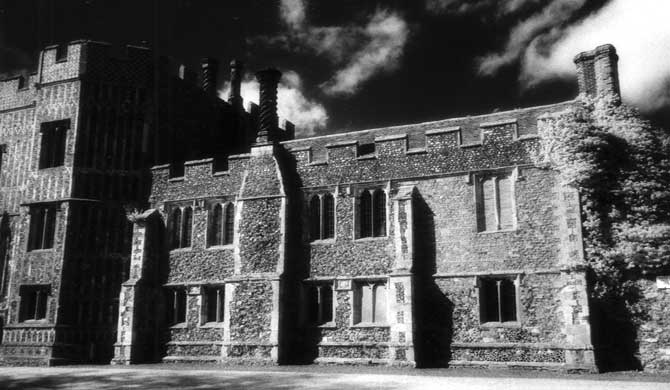
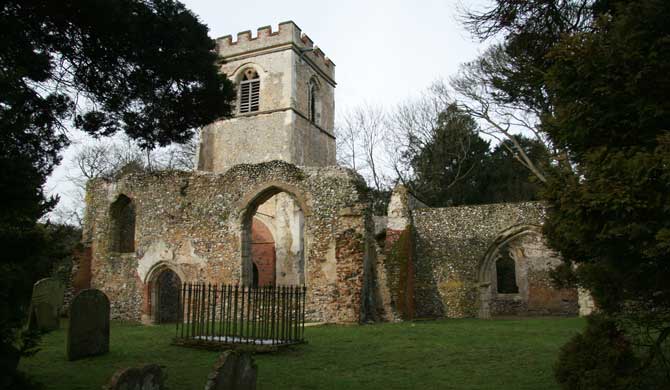
EAST ANGLIA Abbey Ruins. Bury St Edmund's. Nr Peterborough, Cambridgeshire. As the
London-bound express trains thunder at ever increasing speeds past the
Cambridgeshire village of Connington, they race over a tiny crossing, which a
series of tragic accidents
Needless
to say with such a dreadful reputation the crossing had soon acquired a
reputation for being haunted. Signalmen, who were The Crown Inn. Bildeston. Suffolk. The
timeless aura that descends upon you as you enter this 15th century inn, with
its inglenook fireplace and low beams, is quaintly reminiscent of a bygone and
long lost age. A mysterious grey lady has been seen at a window that looks out onto the car park waving a ghostly farewell to departing customers. Two children dressed in Victorian outfits have appeared before startled guests at various points around the Inn, whilst an old man in a tri-cornered hat is frequently seen sitting in a favoured corner of the main bar. For those who enjoy a smattering of haunted hospitality, Room four is the bedroom where guests often experience things going bump in the dead of night. They may be treated to an appearance of the grey lady, or of the “genial missionary” whose presence several visiting mediums have detected. And if neither of these is sufficient to aid a decent nights unrest, there is always the touch of ice-cold fingers that have been known to stroke the necks of sleeping guests. Woodcroft Castle - Nr Helpston Although
private, and extremely difficult to find, enough of the castle can be seen from
the road outside to make the search worthwhile. This moated, turreted little
fortress, with its old battlements, round towers and mysterious dark windows was
once the home of Dr Michael Hudson the trusted Chaplain to King Charles 1st.
During the Civil war he
The Green Children The sign
of this peaceful little village, in the heart of rural Suffolk, commemorates one
of the most curious legends to emerge from the mists of medieval history. The
story was chronicled by two 13th century The boy soon died, but the girl quickly settled into her new surroundings where, having adapted to a normal diet, her skin gradually lost its green hue and she became like any other woman. She was soon able to converse in English and answer the questions that her hosts were eager to ask. She said that she and her brother had dwelt previously in a place called St Martin’s land, where the sun never shone. Its residents, she said, lived in perpetual twilight, although they could see another “land of light” across a river. One day, she and her brother had been tending their father’s sheep, when they heard the beautiful sound of bells and had entered an underground passageway in search of their source. Emerging from the darkness, they had been overcome by a dazzling light and had lain motionless for a time. Startled by those who found them, they had attempted to escape, but were unable to find the entrance to the cavern again and so had been brought to the house where she now resided. In time, the girl married a man from Kings Lynn, and went on to live a long and happy life, leaving behind her a curious enigma over which people have been arguing and pondering ever since. Lavenham
is one of the most beautiful towns in Britain, and is widely regarded as one of
the finest examples of a medieval municipality.
Nr East Halton. Lincolnshire. Remotely
situated and almost majestic in its sturdy elegance, the massive castellated
The
gatehouse and the few scattered remnants of the Abbey that lie beyond its
rotting splintered gates, are reputed to be haunted by Thomas de Gretham, the
14th
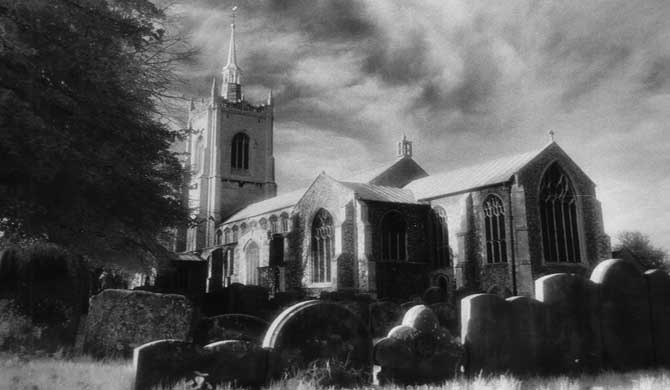
Canewdown. St Nicholas Church. The church tower, built buy Henry V to celebrate his victory at Agincourt, rises majestically above a bleak expanse of wide open countryside. The churchyard, with its scattered, leaning gravestones and dense vegetation, possesses a strangely subdued atmosphere. It is haunted by an old hag, who was long ago executed for witchcraft and who now returns on Hallowe’en much to the consternation of the Essex Constabulary who cordon off surrounding roads to prevent the hordes of ghost hunters who have been known to make pilgrimages here on the night of nights. Canewdown was once renowned for its witches, and any woman seeking membership of the sinister sisterhood, must dance round the church twelve times at midnight, whereupon the devil will appear to perform the necessary initiation. Charlie Wilson was Ostler at this 400 year old inn during the closing years of the 19th century. A small man, whose strange sideways walk earned him the nickname “Spider”, he had the peculiar habit, when drunk, of crawling up the tap- room chimney and emerging, soot covered, from the fireplace of the next bar. One Christmas Eve, however, he decided not to come down and just sat in a bacon curing loft at the junction of the two chimneys, ignoring the entreaties to descend. Exasperated they lit a small fire in the grate, the smoke from which unfortunately suffocated old “Spider”, whose well cured remains are supposedly still up there today! His ghost, though, often descends at night. Dressed in white breeches and shiny leather boots, he does no harm, and is content to flit about the nooks and shadowy recesses of this timeless and little changed old inn. The magnificent priory building, dating largely from the 12th century, is the most imposing monastic foundation to survive in Essex. St Osyth was a 7th century East Anglian Queen, beheaded in nearby “Nuns Wood” by Danish invaders, when she refused to renounce her faith. Her executioners were astonished when she picked up her head and, holding it at arms length, walked to the village church, where she knocked several times on the door before slumping to the ground. Legend holds that every October 7th her ghost repeats the miraculous feat, and can be seen in the churchyard at midnight, holding her severed head. Once home to Matthew Hopkins the self proclaimed “Witchfinder General” who has been described as “.. the foulest of foul parasites, an obscene bird of prey..” and whose fanaticism made his name “stink in men’s nostrils”. Claiming to possess “The Devil’s Own List” of every witch in the kingdom, Hopkins scoured the county imprisoning and torturing his unfortunate victims till they confessed to any number of heinous crimes. From 1645 - 1647 he was responsible for 74 executions, whilst a further 36 people died in gaol awaiting trial. He profited immensely from his work, demanding a fee for every witch he brought to justice, and making the equivalent of £100,000 from his activities. He died in 1647, but the evil he perpetrated in life has apparently prevented his spirit from resting, for his ghostly figure has been seen at the inn on several occasions. The paranormal investigator Harry Price dubbed the old rectory “The Most Haunted House in England” and claimed that over two hundred ghosts resided within its sturdy Victorian walls. Although the house burnt down in 1939, the church and its surrounds are still eerie and many visitors report a sudden feeling of foreboding that grips them the moment they set foot in the neat, though seemingly neglected little churchyard. And, some would say, with good reason, for ghostly organ music has often been heard wailing from inside the empty church. Investigators have tape-recorded phantom footsteps, mysterious tapping, and even a harsh, menacing cry that has terrified those who have heard it. Many photographs taken of the church exterior have been found to include ghostly forms gliding amongst the sunken graves or along the uneven paths of what is still one of England’s eeriest and marrow - chilling places. The hotel stands over the river which once drove the mighty wheel that can still be seen encased behind glass in the restaurant. When the building was a mill a lady is said to have drowned beneath the wheel and her ghost still haunts the older sections of the hotel. Cleaning staff will not venture alone into some of the older rooms, and those who find themselves alone in the restaurant late at night can find it an unnerving experience. Displayed beneath the floor in the hotel foyer lie the mummified remains of a cat, its facial features frozen in an eternal snarl. Bricked up to bring good luck to the original mill building, it was rediscovered in 1971 when the mill was converted to a hotel. Whenever the cat is removed from the hotel a spate of bad luck always follows. In 1999 the cat was removed. Over the next few weeks the Road outside the hotel exploded, the managers office flooded several times and the person who had removed the cat met with an accident. All returned to normal once the cat had been returned. The Abbey Ruins. The passage of time has left the once proud arches of what must have been a magnificent Abbey, mouldering in decay. Its haunting buttresses have tottered and fallen. Its stark stone columns now loom over eerie crumbling walls, whilst hollow windows look mournfully down on the shattered cloisters and scattered aisles where monastic feet once shuffled in peaceful contemplation. But when the glint of a full moon casts dancing shadows across the ruins, ghostly monks have been known to walk amidst the once proud walls or to stand silently by the old gatehouse of what is acknowledged to be one the most spiritually charged locations in England. Primitive and mysterious, Wicken Fen has changed little since the days when Hereward the Wake roamed its marshy expanse, battling against the Norman invaders. At night, its wild avenues of beech and rowan tower over beds of giant reeds through which the breeze whispers eerily, and where the sudden movement of a tiny mammal is easily mistaken for the advance of something far more sinister. Strange, twisting shades of Roman legionaries, perhaps? For they have been known to materialise before startled witnesses and then melt back just as suddenly into the silent shadows. Battles fought long ago are still repeated by phantom armies that are heard though never seen. A sinister black dog wades through the dark waters its eyes fixed on an unseen prey. But the most feared of all the spectres that roam this brooding wilderness, are the “lantern men”. These strange lights that dance and twist their way over the dark surface of the great mere or skip erratically in and out of the reeds, are said to be evil spirits whose sole intent is to lure unsuspecting mortals to a hideous death and a watery grave deep within their marshy domain. Potsford Wood is a creepy eerie place even on the brightest of summer days. Almost lost amidst its creeping carpets of nettle and bracken are the decaying remains of the Potsford Gibbet, last used on 14th April 1699 when Jonah Snell was executed for murder. The secluded wood is a truly frightening place to be on wild, winter nights. The skeletal trees stand gaunt and shadowy, their branches reaching out to grip one another in grim embrace. Locals speak in hushed tones of strange lights that twinkle from the depths of the wood. Strangers talk of a fearsome choking groan that that sounds alongside them. Some who have paused to gaze upon the rotting remains of the old gibbet, have turned to find a mysterious figure in black standing behind them, and are horrified to see that beneath its dark cloak there is nothing more than a grimacing, hollow - eyed skull staring at them. Dunwich -The Town that Vanished What was once the sixth largest town in England, is now little more than a tiny, atmospheric, sea-side village and to stride along the shoreline at twilight is to feel the true thrill of Haunted England. The gulls wheel about you, their raucous cries intermingling with the thunderous percussion of the crashing waves. Legend speaks of these birds being the souls of long dead fishermen. History tells that their once great town of Dunwich now lies submerged beneath the foaming waters of the very sea that stretches out before you. But in a quiet moment when the gulls fall silent , and the wild waves retreat to prepare their next assault , you may hear the ghostly bells of the towns churches tolling their mournful knell from beneath the swell, their dull melodies drifting with the mists upon the sea breezes. You may even see the swirling shapes of long dead citizens drifting across the cliff tops. And you will know in that moment of peace and quietude, that you have walked with ghosts on Dunwich shore. Holywell -The Old Ferry Boat Inn An isolated setting on the leafy banks of the Great Ouse, a thatched roof over ancient oak beams beneath which massive Inglenook fireplaces blaze a warm welcome, combine to make the Old Ferry Boat one of Cambridgeshire’s most atmospheric inns. Its stone floor is now hidden beneath a plush carpet. Except, that is, one rectangular slab of ancient granite which they would never dare cover, for beneath it are said to rest the mortal remains of Juliet Tewslie. Neglected by her lover, Tom, the inconsolable girl is said to of hanged herself on March 17th in about the year 1078. On finding Juliet swinging from the branches of the very oak beneath whose leafy boughs they had come a courting in happier days, her grief stricken lover cut her down and cradled the lifeless body in his arms. Having said his last sorrowful and poignant farewell, he buried her where she had died and marked the spot with the granite stone over which the picturesque old inn now stands. But Juliet does not rest in peace, for every year on the anniversary of her tragic demise, her ghost is said to rise at midnight, and float about the old rooms of the old inn, until the last knell of the midnight bell calls her back to the grave, where she disappears to sleep in peace for another year. Such is her posthumous fame that March 17th is THE night at The Old Ferry Boat. The night when ghost hunters and the just plain curious come flocking in their thousands to greet the appearance of the poor girl whose tragic end, and subsequent nocturnal jaunts, have helped make her one of Cambridgeshire's most abiding annual fixtures. Blickling Hall was built in the early part of the 17th century for Sir Henry Hobart, although the ghosts that reputedly haunt it are those of the occupants of a previous hall on the site. It once belonged to Sir Thomas Boleyn, father of the ill-fated Anne Boleyn. It was she who having caught the eye of King Henry V111, became his mistress and ultimately his second Queen, before finding herself accused of treasonable adultery, sexual deviation (with among others her own brother, Lord Rochford) and, worst of all - witchcraft. Sentenced to death by her own uncle, the Duke of Norfolk, she was beheaded on 19th May 1536 by a skilled swordsman specially imported from France for the occasion - her husbands one merciful concession to his fallen Queen. Her ghost is now one of the busiest in England, but it is here at Blickling on the anniversary of her death, that she makes her most dramatic appearance. Indeed the auspicious date is something of a ghostly family re - union in these parts. Anne herself appears dressed all in white, seated in a ghostly carriage that is drawn by headless horses, spurred on by a headless coachman. She too is headless - her severed, dripping head sitting securely in her lap as the ghastly vision careers along the drive of Blickling Hall and upon arrival at the door the coach and driver vanish leaving the headless Queen to glide alone into the hall where she roams the corridors and rooms until daybreak. Her brother, Lord Rochford, appears on the same night. He too is headless although he doesn’t enjoy the comfort of a carriage, for he is dragged across the surrounding countryside by four headless horses. Not be left out of this unearthly family get together, her father, Sir Thomas Boleyn, has been given a dreadful penance to perform on the anniversary of her death. Once a year for a thousand years from his death in 1539, he must attempt to drive his spectral coach and horses over twelve bridges that lie between Wroxham and Blickling, the impossibility of his task is made even more difficult by the fact that he carries his head under his arm, which make controlling the horses a difficult task indeed! A final spirit to haunt Blickling Hall is thought to be that of Sir Henry Hobart, who died of his wounds in the house following a duel in 1698. It is reported that his dying groans still echo down the centuries from time to time, chilling the blood of all that hear them. Potter Higham - Hickling Broad In summer the broad is alive with the laughter and enjoyment of the thousands of pleasure seekers who turn its picturesque waters into a congested tangle of every conceivable type of sailing craft. In winter, as the cold wins rustle the reeds and the waters so picturesque in the summer have turned to dark and melancholic ice, those who have cause to be in the neighbourhood often gather round blazing log fires, ale in hand and they listen. The wind may rattle the windows, its mournful whistling howling like a banshee across the rooftops - but every so often there sounds from the depths of the broad the rhythmic tattoo of a distant drum and they nod to one another, knowing that the phantom drummer is once more abroad. He lived in the early years of the 19th century, a poor drummer boy, who fell in love with the daughter of a rich and influential man. Knowing that her father would never consent to their marriage they wed in secret. Each night they would meet in a small hut on the edge of Hickling Broad. In winter when snow blanketed the countryside and the Broad was frozen over, she would come to their humble love nest and await his arrival. Skating on the frozen ice he would sound his approach by beating on his kettle drum. Then one night as waited, listening to the beat of her approaching husbands, all went suddenly quiet. The ice had given way and sent her lover to a chilling death deep beneath the frozen broad. And so it is that on winter nights when people stay huddled indoors, their windows bolted tight against the winter winds, that the rhythmic tattoo of a ghostly drum sounds across the broad and the phantom drummer resumes his eternal search for the girl whose heart he won but whose spirit he lost long long ago. Family seat of the Marquess of Townshend, Raynham Hall is also home to “Brown Lady”. She is thought to be the ghost of Dorothy Walpole, sister of the Statesman Sir Robert Walpole, whose husband Lord Charles Townshend imprisoned her in her quarters at the hall when he discovered her affair with the rakish Lord Wharton. Crestfallen she either wasted away until her death in 1726, her suffered a mysterious, not to say suspicious, tumble down the grand staircase where she broke her neck. her ghost has become a classic of English haunting with its strangely illuminated face from with dark hollows instead of eyes. The novelist Captain Maryatt encountered her in a corridor one night when he was staying at the hall. She “glanced at him in the most diabolical manner” upon which he drew his pistol and shot her. The bullet passed straight through the phantom and was later discovered embedded in a door A Country Life Photographer even succeeded in taking a photograph of the ghost in 1936 which continues to baffle experts who can find no evidence of trickery or fakery. The imposing Norman castle was built in 1150 onto ramparts that had probably been constructed by the Romans. In 1330 Edward 111 sent his mother Queen Isabella to live here in unofficial imprisonment for her part in the savage murder of her husband Edward 11. She lived in relative comfort to begin with. But then “the She Wolfs” mind gave way and she degenerated into insanity and became gibbering, screaming, cackling wreck. Although she drew her last tortured breath here over 600 years ago her raucous cackle and maniacal ghostly laughter are still heard echoing from a room on the upper levels of the Castle and they are loud enough to send a cold chill racing down the spine of those who happen to hear them. The text on this page is the copyright 2004 of author Richard Jones. It may not be reproduced in any form whatsoever without the express permission of the copyright holder or of his publishers, New Holland Publishers Ltd.
|