CORNWALL'S LEGENDARY GIANT FIGHTER
St. Michael's Mount, Cornwall
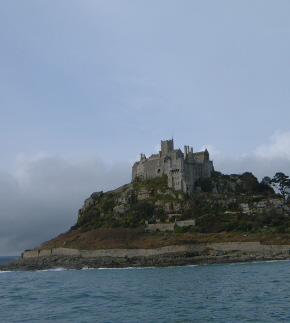
Rising from the sparkling waters of one of England’s prettiest bays, St Michael’s Mount is a rocky jewel, whose magic slowly draws you across its sea-sprayed causeway on which, with each exhilarating step, you find yourself sinking ever deeper beneath its ancient spell of mysterious enchantment.
The Mount has a long and varied history. It has seen use both as a church and a Priory.
The lofty castle that crowns its summit dates from the 12th century, and has been the private home of the St Aubyn family since 1659.
Tradition holds that the island was at one time the eastern border of the lost land of Lyonesse.
Legend maintains that King Arthur once battled a ferocious giant on its rock-strewn shoreline.
It is, however, the Mounts association with another mythical figure that has transcended the centuries to be recounted time and again in storybooks the world over.
Tales of Jack the giant killer have swirled around the eerily beautiful Cornish coastline for nigh on six hundred years.
But it wasn’t until the 18th century that the heroic exploits of this local farmers son found their way into the national consciousness, and thereafter, onto a worldwide stage.
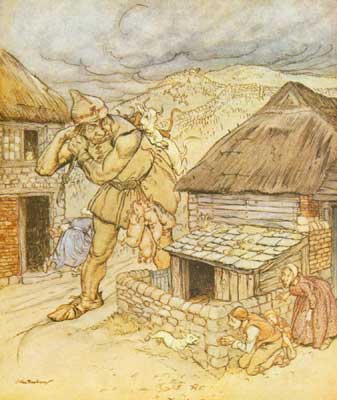
In his earliest incarnation Jack was a popular folk hero who came to St Michaels Mount to rid the mainland from the scourge of a wild and unruly giant named Cormoran.
This hideous creature, whose fierce and savage aspect was the terror of the district, was eighteen feet tall and three yards round.
Each night he would leave his gloomy lair atop the rock, and wade across the bay, to plunder the cattle of his mainland neighbours.
But one evening Jack swam over the sea to the Mount and dug a deep pit, which he covered with bracken, sticks and earth.
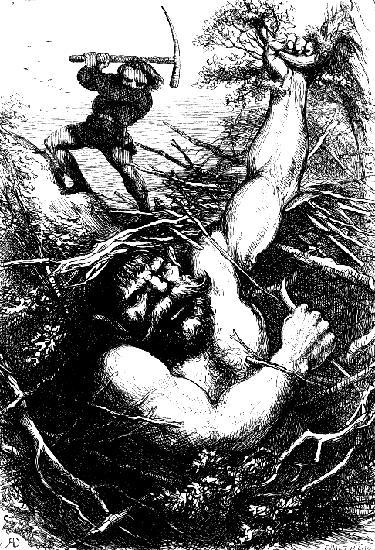
The trap set, he waited for dawn to break, and then blew loudly on his horn to rouse the sleeping colossus, who raced angrily towards him, thundering as he came "you saucy villain, you shall pay dearly for breaking my rest, I shall broil you for my breakfast."
Moments later the ground gave way, and the astonished Cormoran tumbled headlong into the pit, where Jack finished him by sinking a pickaxe into his skull.
When the justices of Cornwall heard of the giants defeat, they sent for the brave lad and declared that from that day forth he should be known as "Jack the Giant Killer." They also presented him with a sword, and a belt on which was inscribed, in gold lettering,
This is the valiant Cornishman
Who slew the giant Cormoran.
Thereafter Jacks adventures took him far and wide.
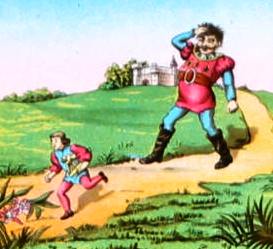
En route for Wales he killed two more giants who wished to avenge Cormoran’s death.
Later he became a devoted servant to King Arthur’s son and, whilst seeking food for his hungry master, tricked another giant into giving him four magical possessions.
A sword that could cut through anything; a coat that rendered him invisible; a cap that made him all- knowing; and a pair of shoes that enabled him to outrun anyone or anything.
Suitably armed he was able to lift the spell that an evil magician had cast over a beautiful princess, whom the prince wished to marry.
He was rewarded by being made a Knight of the Round Table, in which capacity Arthur set him the task of ridding Wales of the many giants that were terrorising the country.
So began Jack’s most famous encounter, as he pitted his wits against the ferocious, two headed giant, Thundel, who had sworn vengeance for the slaughter of his kinsmen.
Thanks to the coat of invisibility, his savage adversary was unable to see Jack. He could, however, smell his hidden prey, and thus it was that from Thundel’s lips came what is undoubtedly the most famous utterance of the whole saga: -
Fa, fe, fi, fo, fum
I smell the blood of an Englishman.
Let him be alive, or let him be dead.
I’ll grind his bones to make my bread.
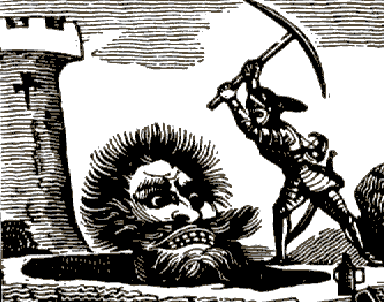
Unperturbed, Jack lured the giant onto a booby-trapped drawbridge, through which Thundel crashed into a deep moat, where the noble knight promptly beheaded him.
In Jack’s final adventure he rescued a beautiful maiden from a mountain top castle in which a wicked wizard had imprisoned her.
Her delighted father granted Jack her hand in marriage, and the couple went on to live happily ever after on a vast estate presented to them by a grateful and admiring King Arthur.